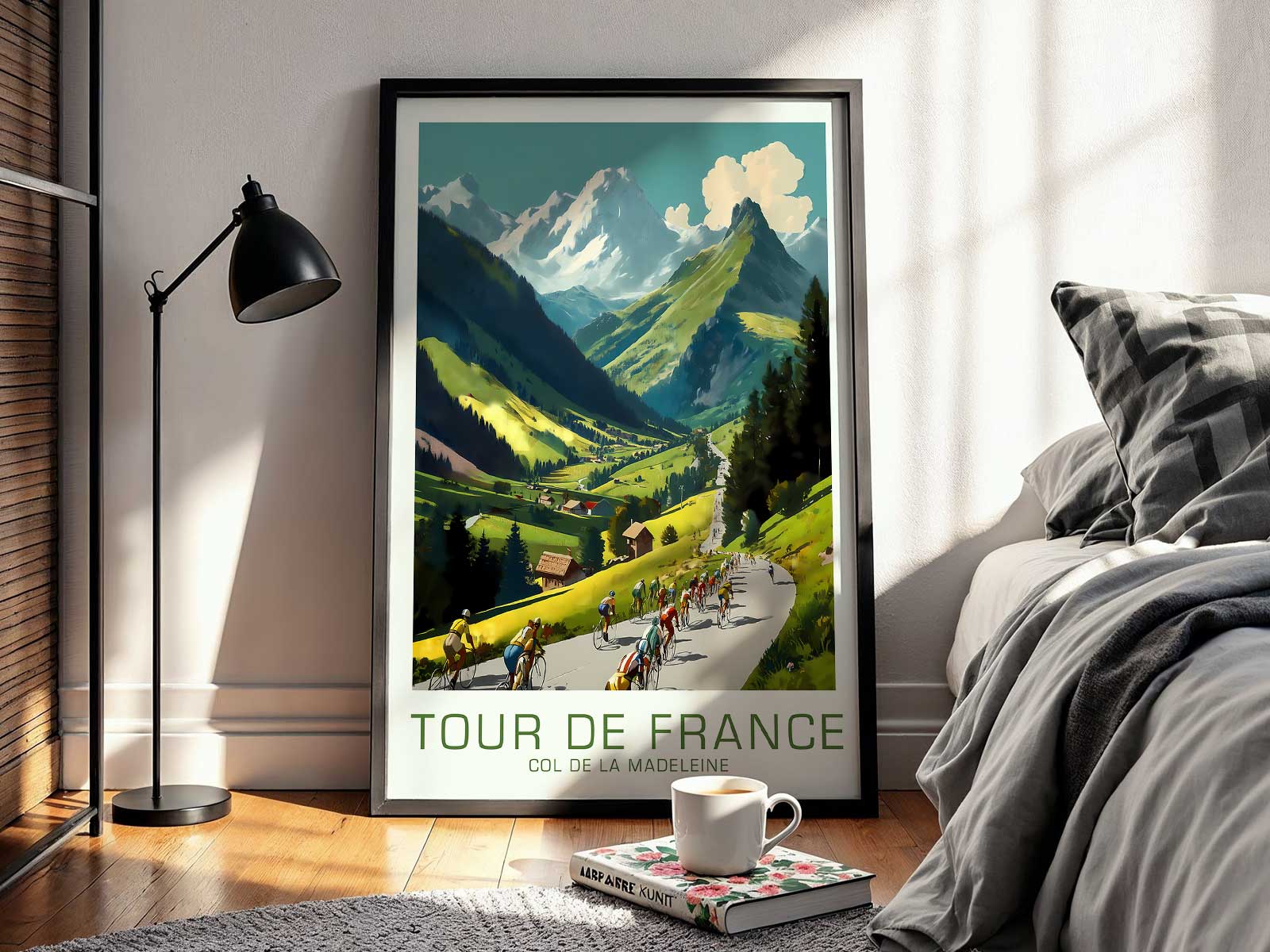
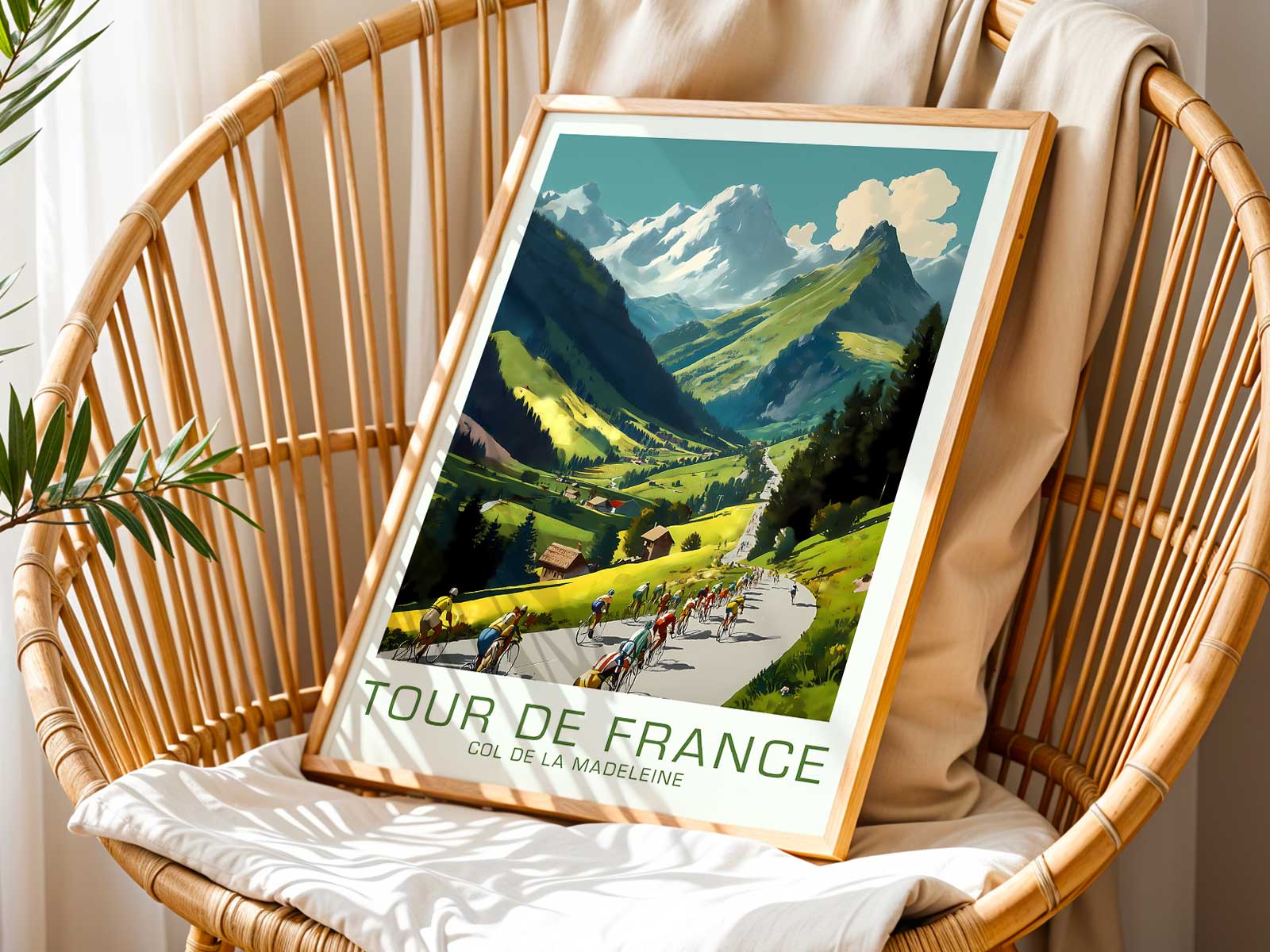
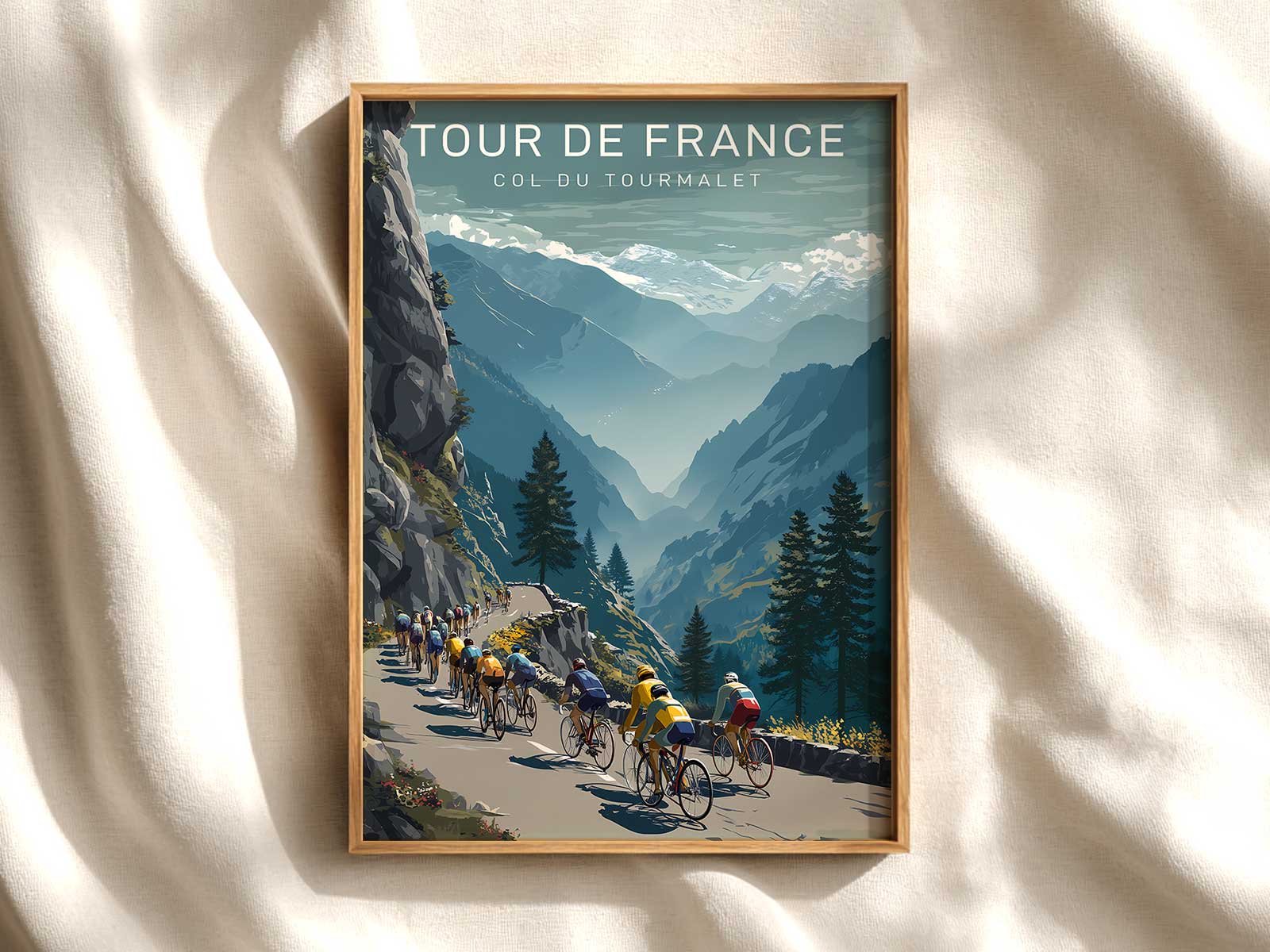
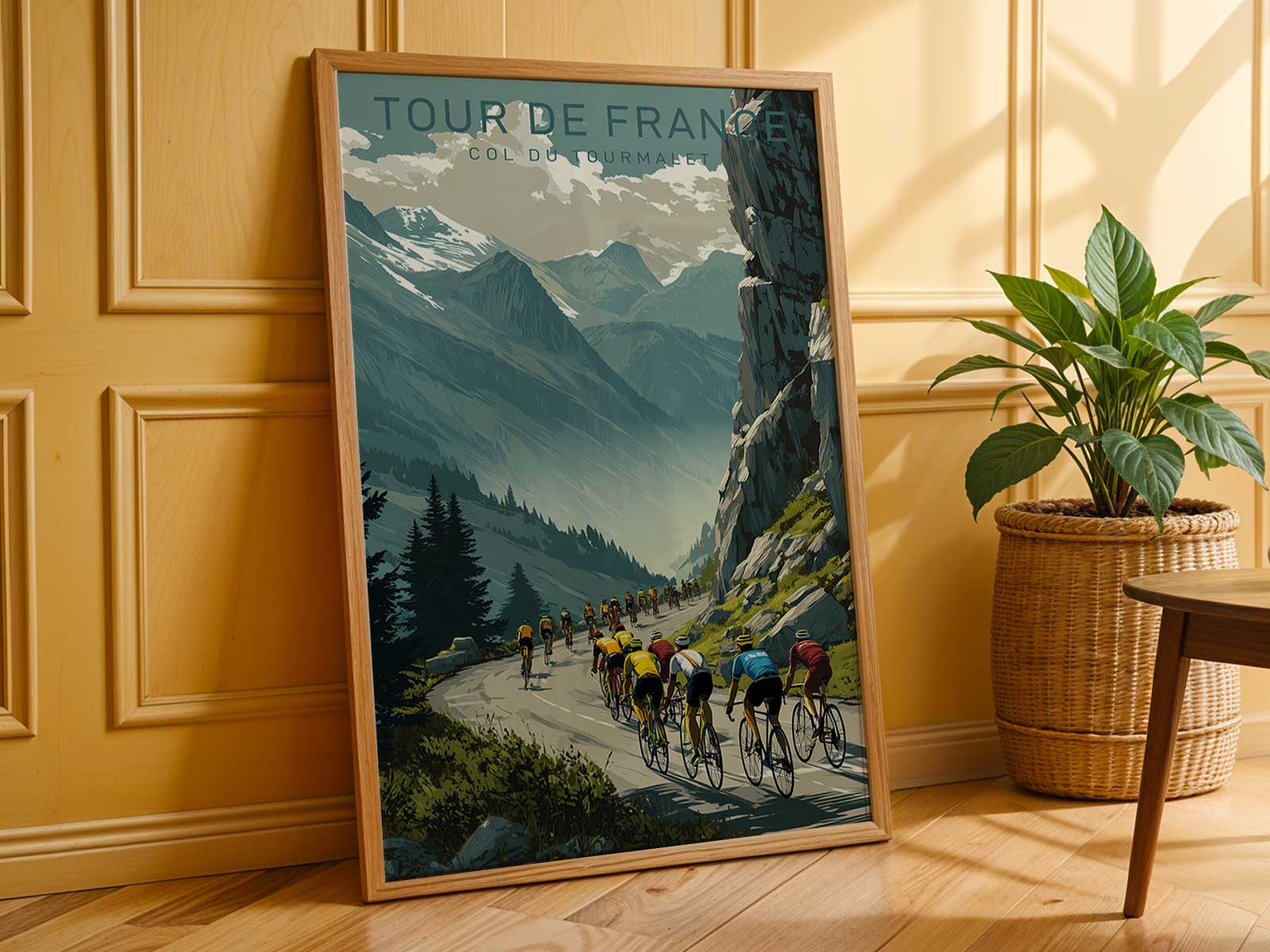
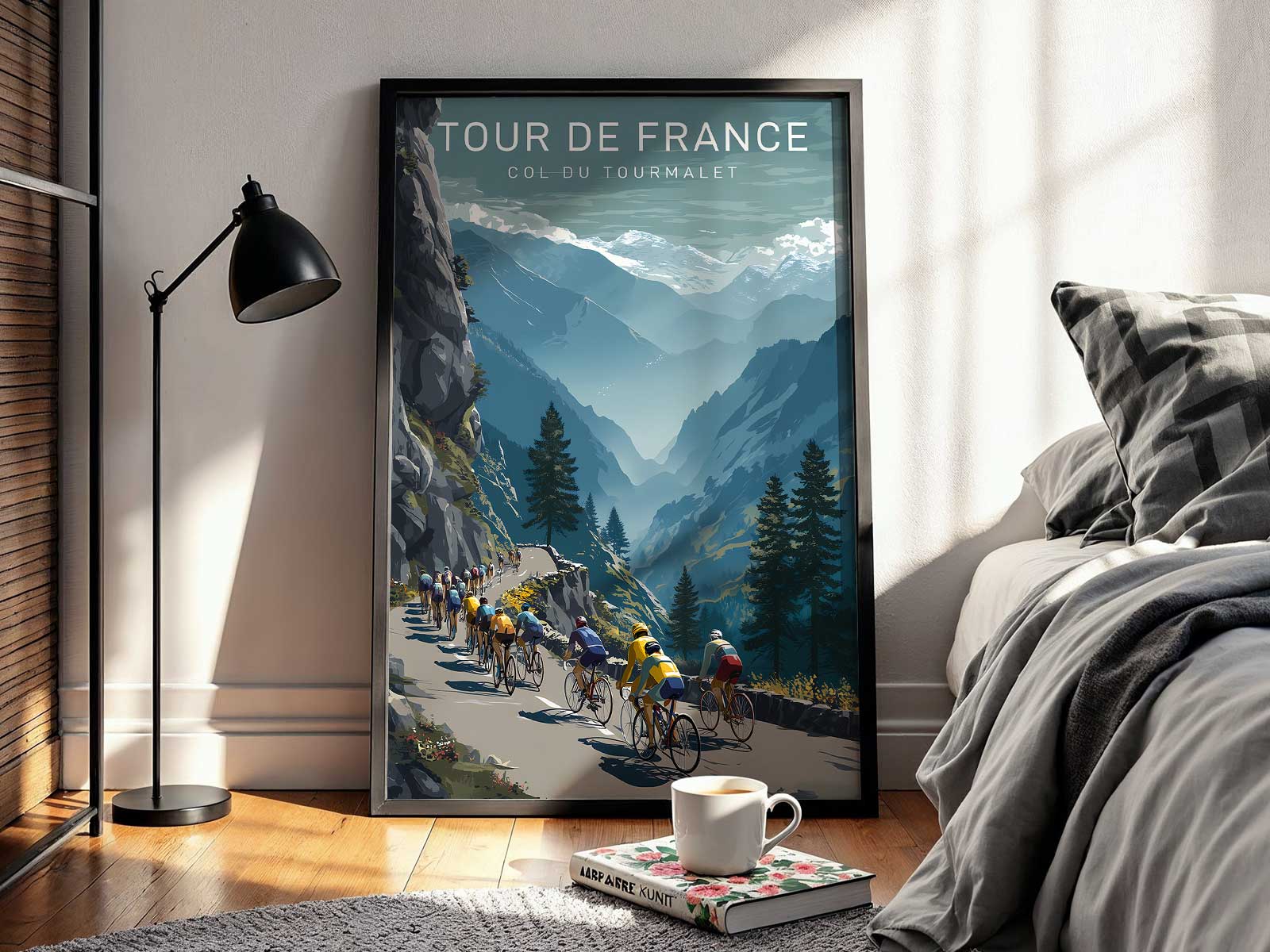
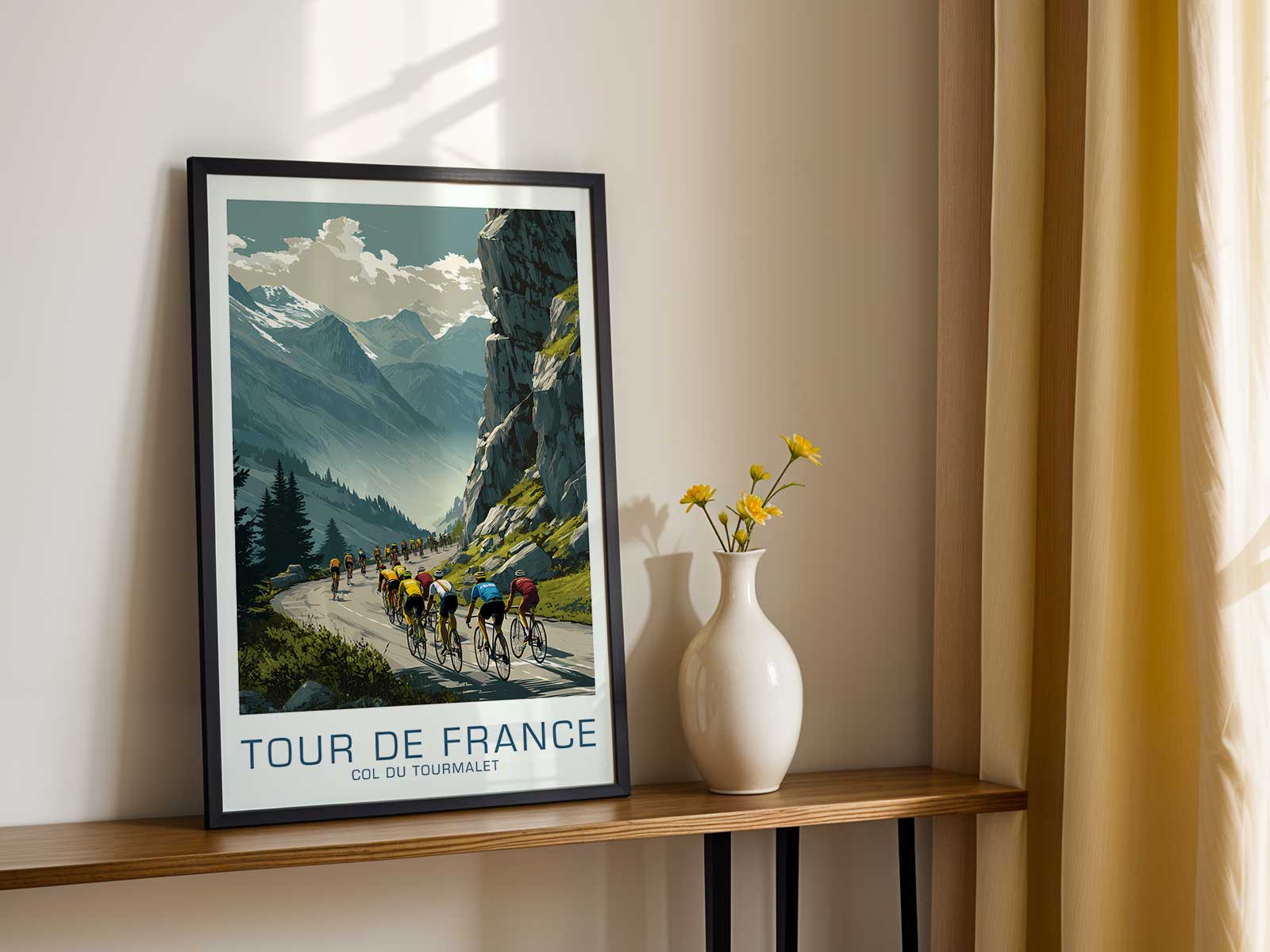
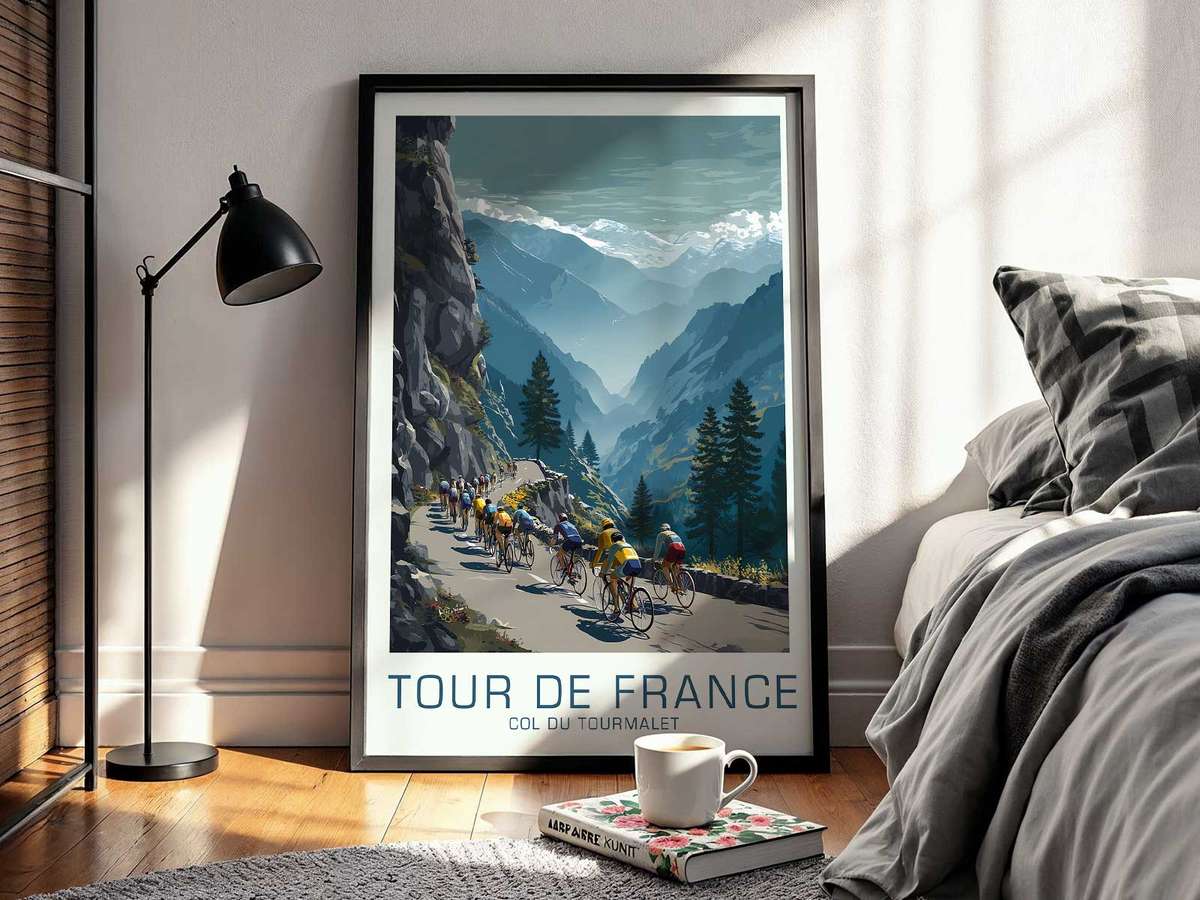
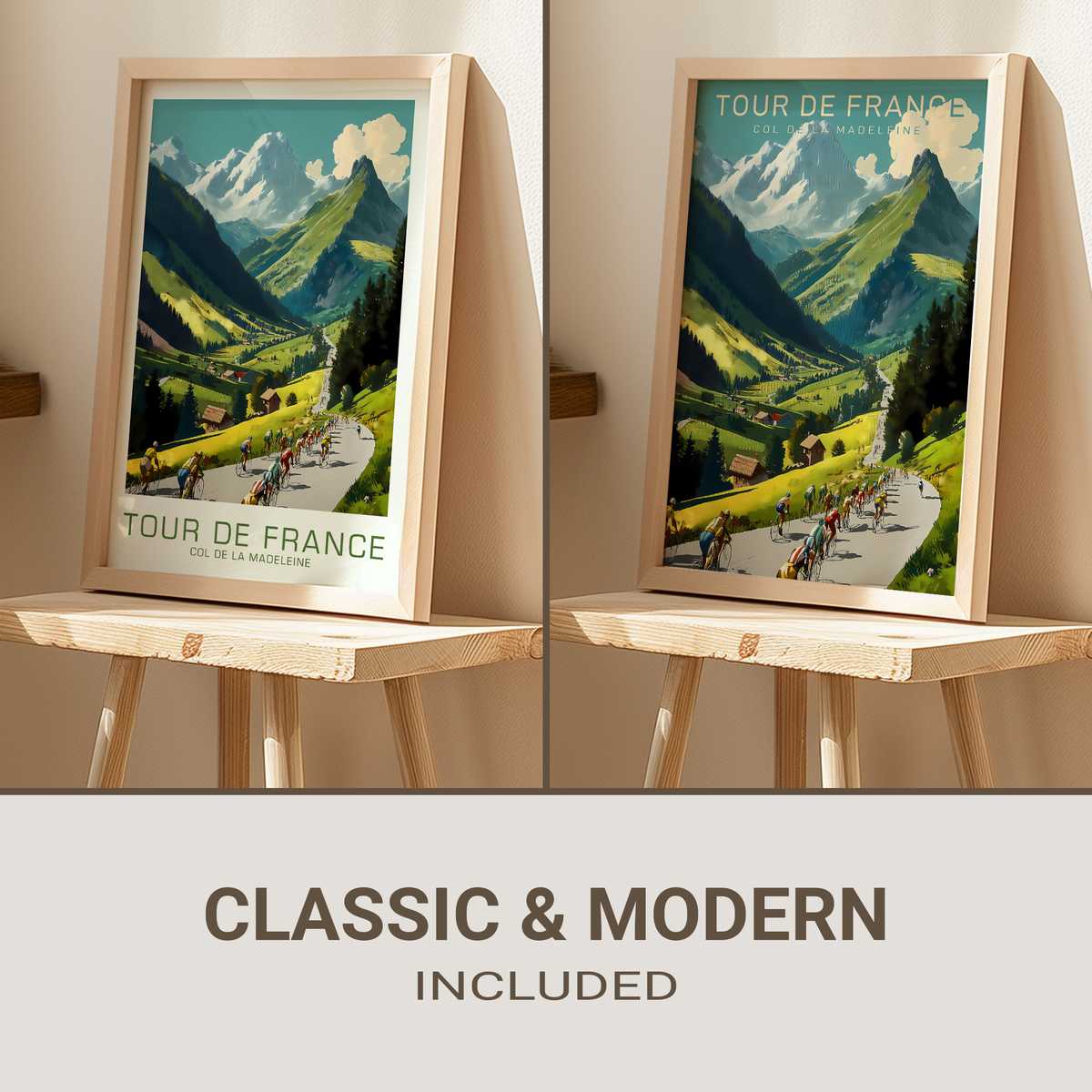
The Col du Tourmalet is one of the Tour de France’s most iconic climbs — an hors catégorie pass whose summit sits at roughly 2,115 metres and whose long, steep approaches have become a recurring stage drama. A successful vintage-style poster of the Tourmalet does more than show a road: it translates the climb’s length, gradient and altitude into visual shorthand so a living room or studio can feel the labour and the scale of a great mountain stage.
Designers draw on concrete, repeatable facts about the Tourmalet to ground their imagery. Typical ascents from Sainte-Marie-de-Campan cover around 17–19 kilometres with average gradients near 7–7.5% and sections that exceed 10%. Those statistics inform the poster’s compositional choices: a long diagonal that slices the frame suggests sustained incline, repeated roadside markers or hairpins indicate distance, and steep sections are implied by sharper, more acute diagonals or compressed perspective. Together these devices recreate the physical sensation of climbing — the unending slope, the shifting rhythm of the pedals, the slow passage of the landscape.
[IMAGE_INSERT_ARTICLE_01]
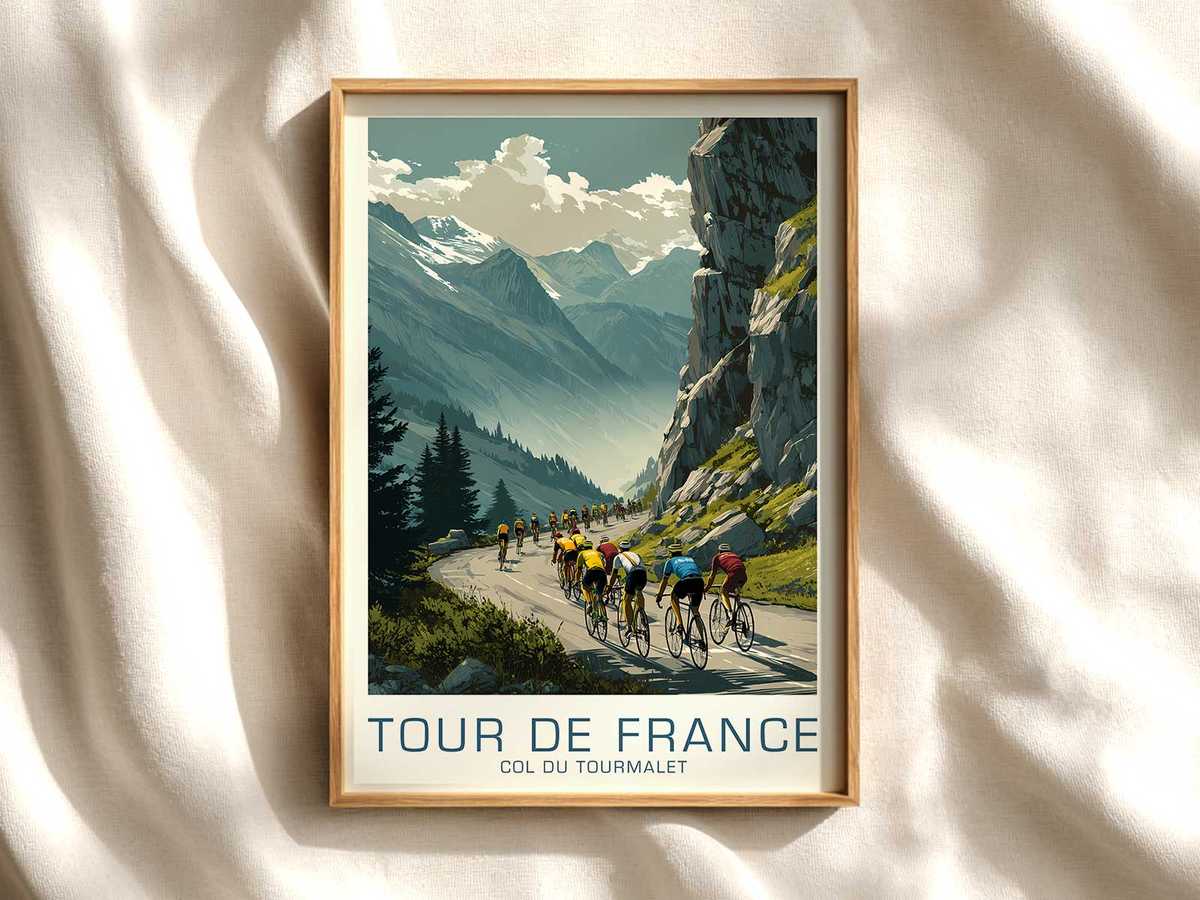
Altitude is another visual language in itself. At about 2,115 metres the summit brings alpine textures: stony ground, reduced vegetation and high-contrast skies. Vintage-style prints use cooler color temperatures, crisp horizon lines and reduced midground detail to give depth and the sensation of thin air. Scale contrasts — very small cyclists against vast ridgelines or monuments commonly found at the Tourmalet summit — reinforce the human effort required to cross such a pass. The presence of commemorative monuments at the summit is a recognizable landmark that anchors a poster’s narrative: it tells the viewer this is not just a steep road but a place steeped in Tour memory.
Light and weather become dramatic tools. Directional lighting across the slope carves out contour and emphasizes gradient; long shadows and low sun angles suggest early morning or late afternoon attacks, times when riders feel the climb most keenly. Designers often warm the foreground light while keeping the distant peaks cooler to evoke both the proximity of effort and the remoteness of altitude. This temperature contrast helps a poster deliver an immediate emotional charge — the intimacy of the rider’s battle in the foreground set against an indifferent, monumental landscape.
Beyond technique, the stage atmosphere gives these prints their narrative pull. The Tour briefly transforms villages, mountain roads and cols into theatre: tight stone villages become sentry points for eager crowds; narrow roads funnel attention into a single vanishing line; roadside flags and scattered spectators punctuate the otherwise harsh alpine terrain. Even in a pared-back vintage composition, hints of crowd mood — a cluster of tiny silhouettes, a row of pennants, a roadside café awning — suggest the communal drama that makes a mountain stage feel momentous.
Why does this imagery work so naturally as wall art? A stage-led print centers on process rather than result. The road itself becomes protagonist: its slope, its length, its exposure to weather and altitude tell a story of sustained effort. That narrative maps well onto domestic and professional interiors because it brings movement and scale without overt action. A single diagonal road through a wide sky introduces tension and direction; cool mountain light adds calm clarity; historical markers and monuments supply cultural weight. The result is a poster that reads as both a scenic landscape and an emblem of endurance.
In a study of visual strategies, designers of vintage and vintage-style Tourmalet prints rely on classic compositional devices — silhouette, diagonal lines, scale contrast and color temperature — to communicate distance, incline and atmosphere. These choices let a print convey the climb’s concrete attributes (length, average gradient, summit elevation) while translating the subjective sensations riders and spectators describe: prolonged effort, changing terrain and the emotional lift of reaching a storied summit. Framed on a wall, such an image becomes a quiet epic — a reminder of how road, landscape and light together create the drama that defines mountain stages of the Tour.