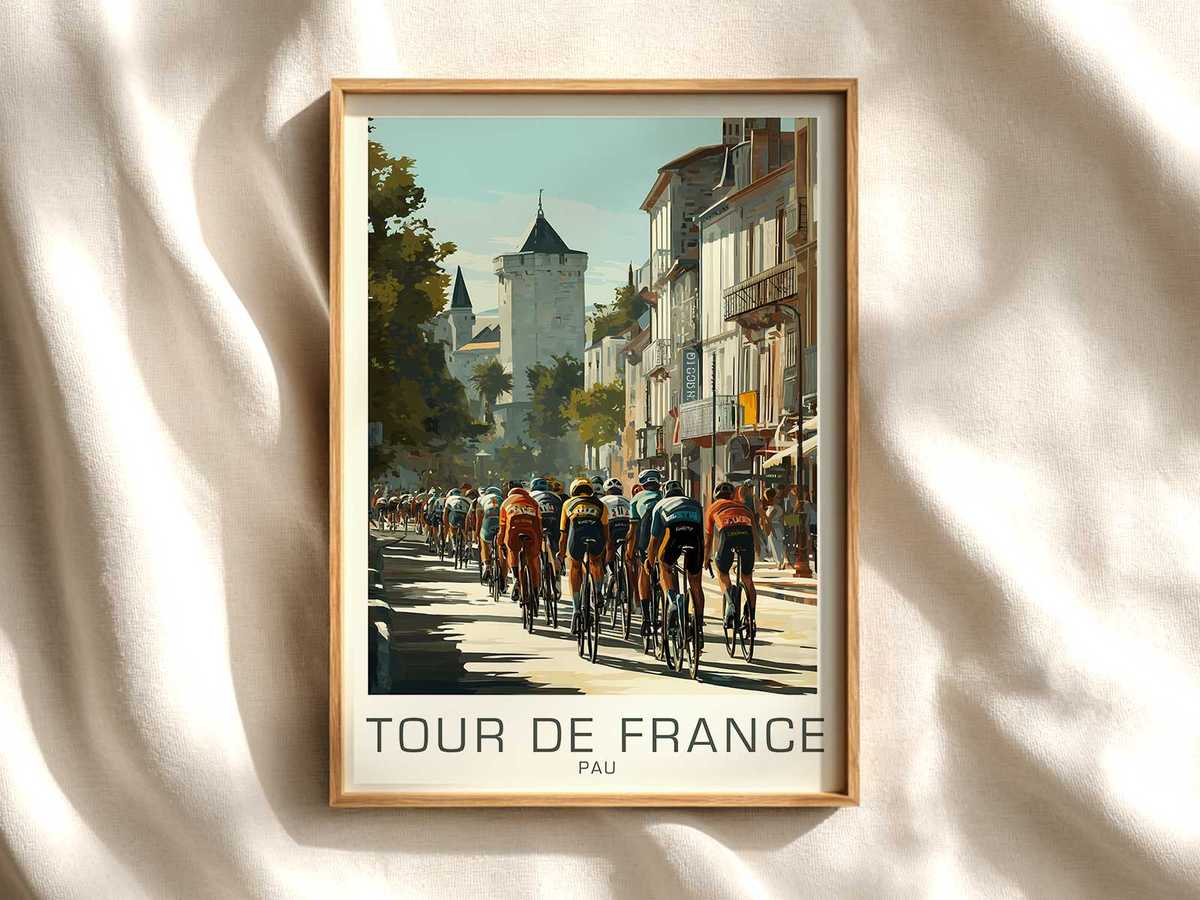
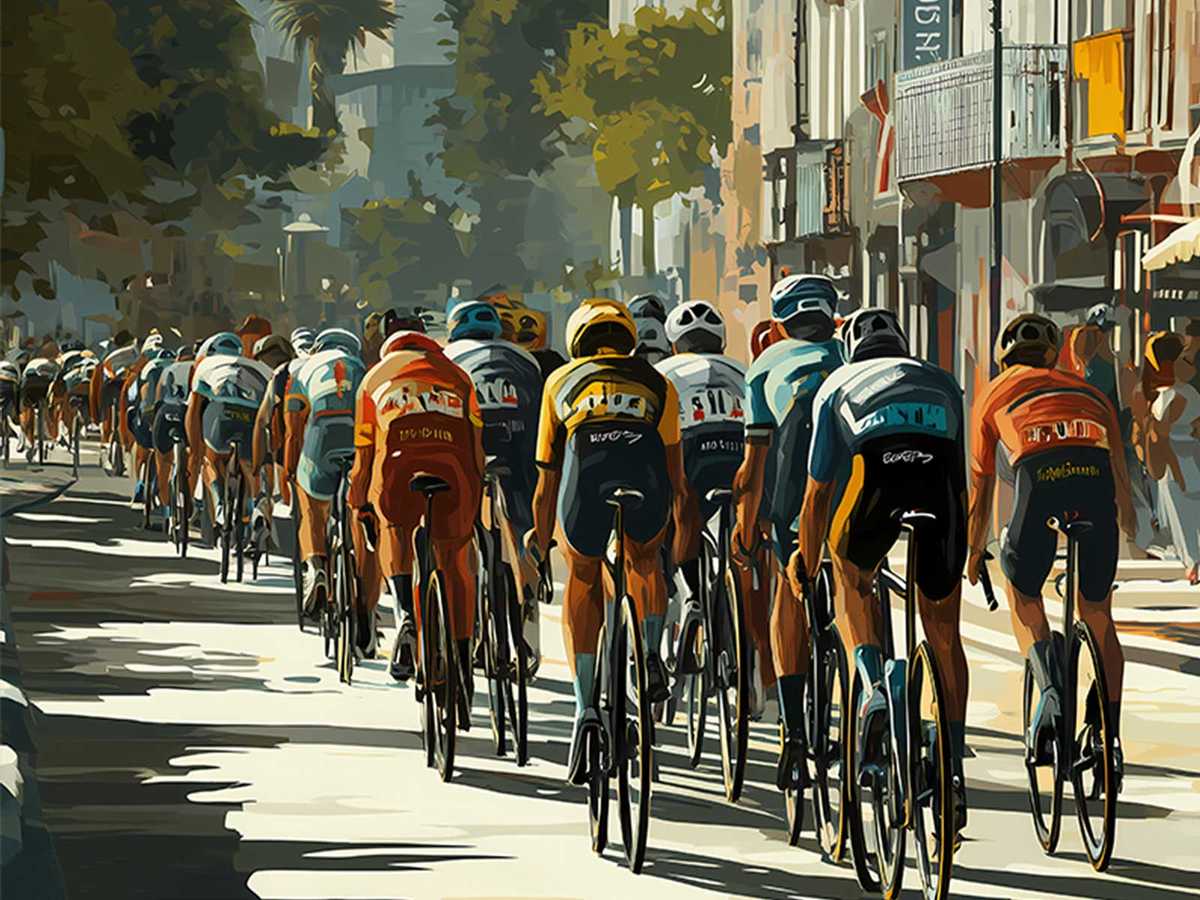
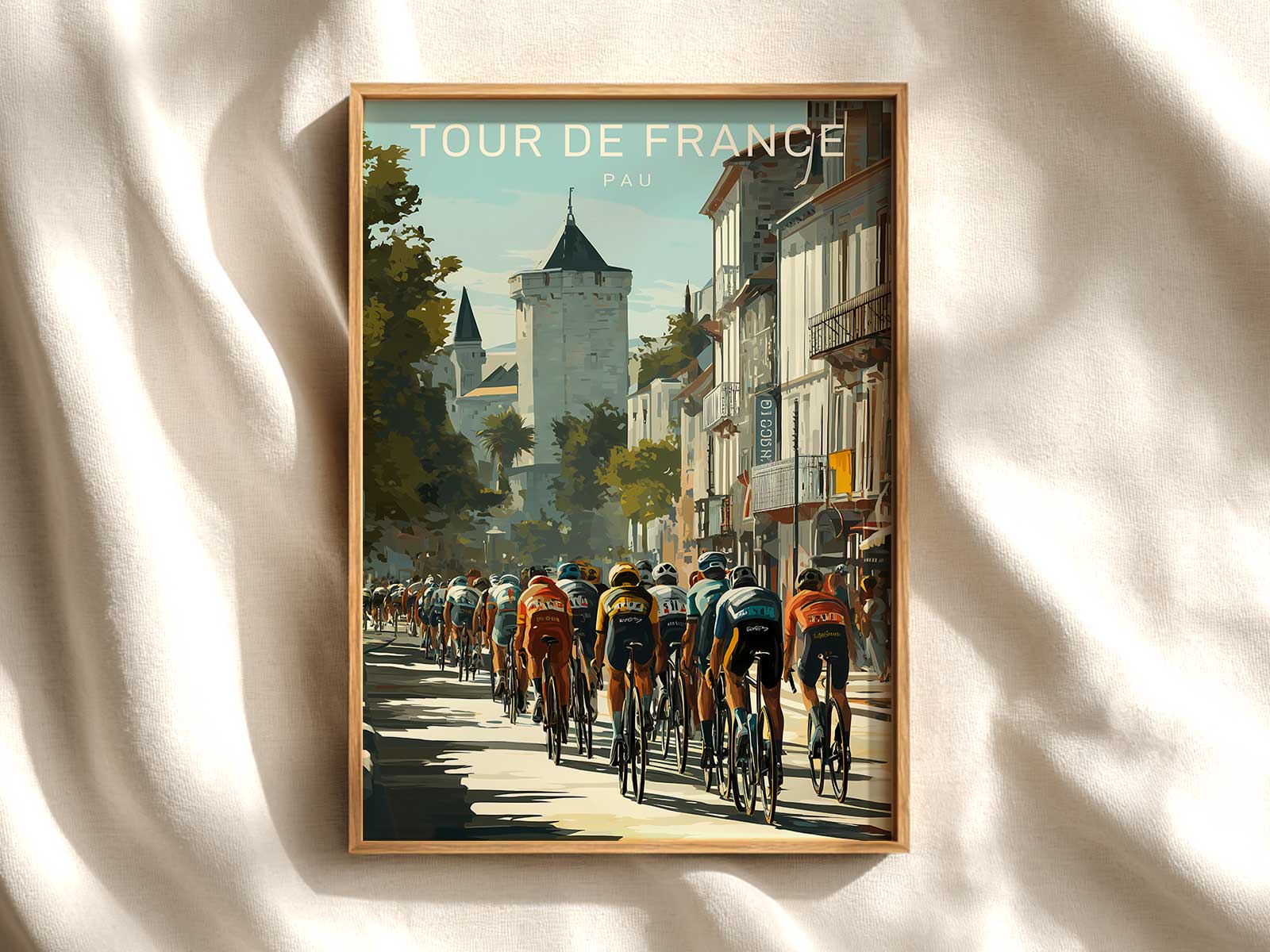
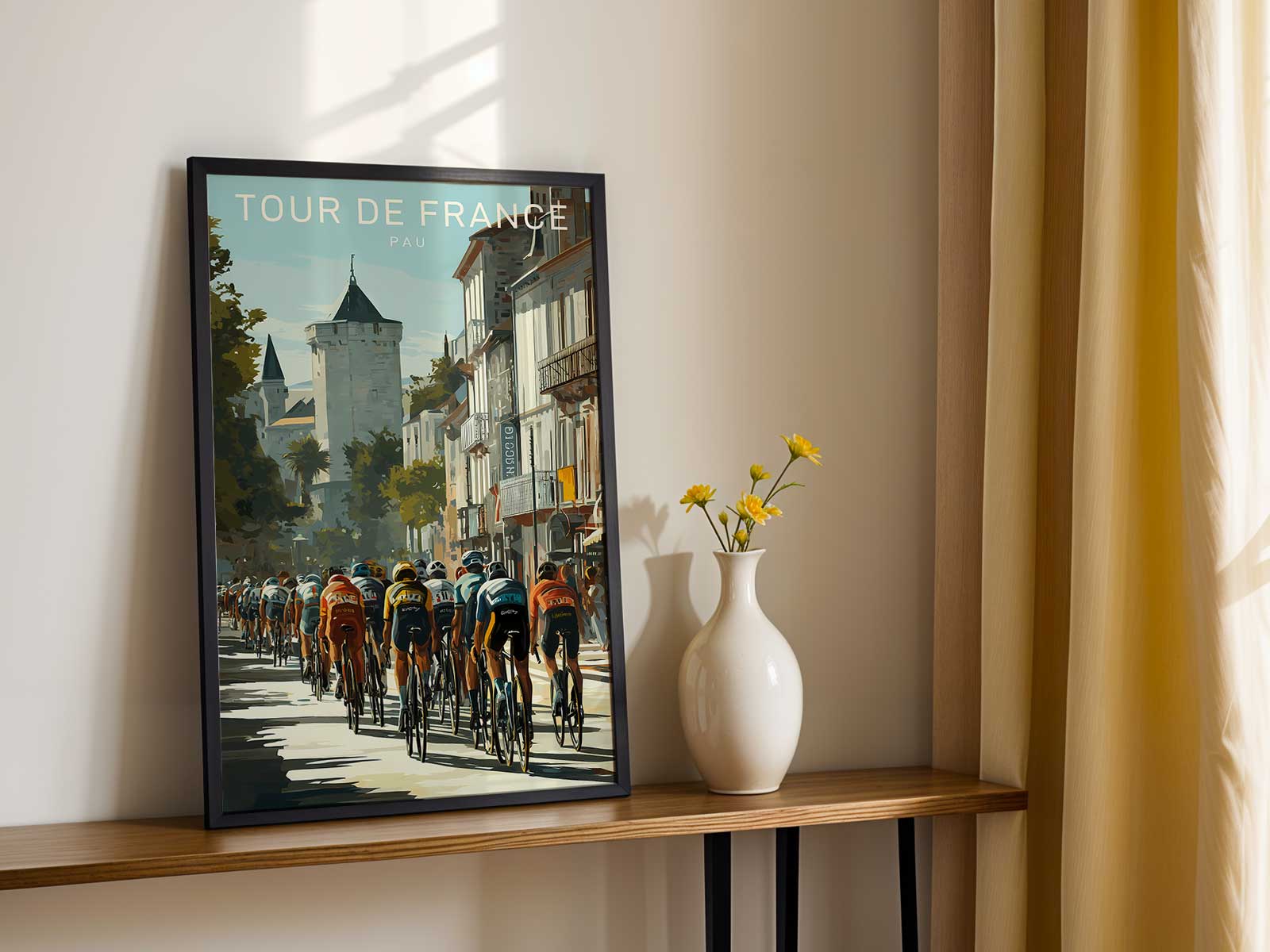
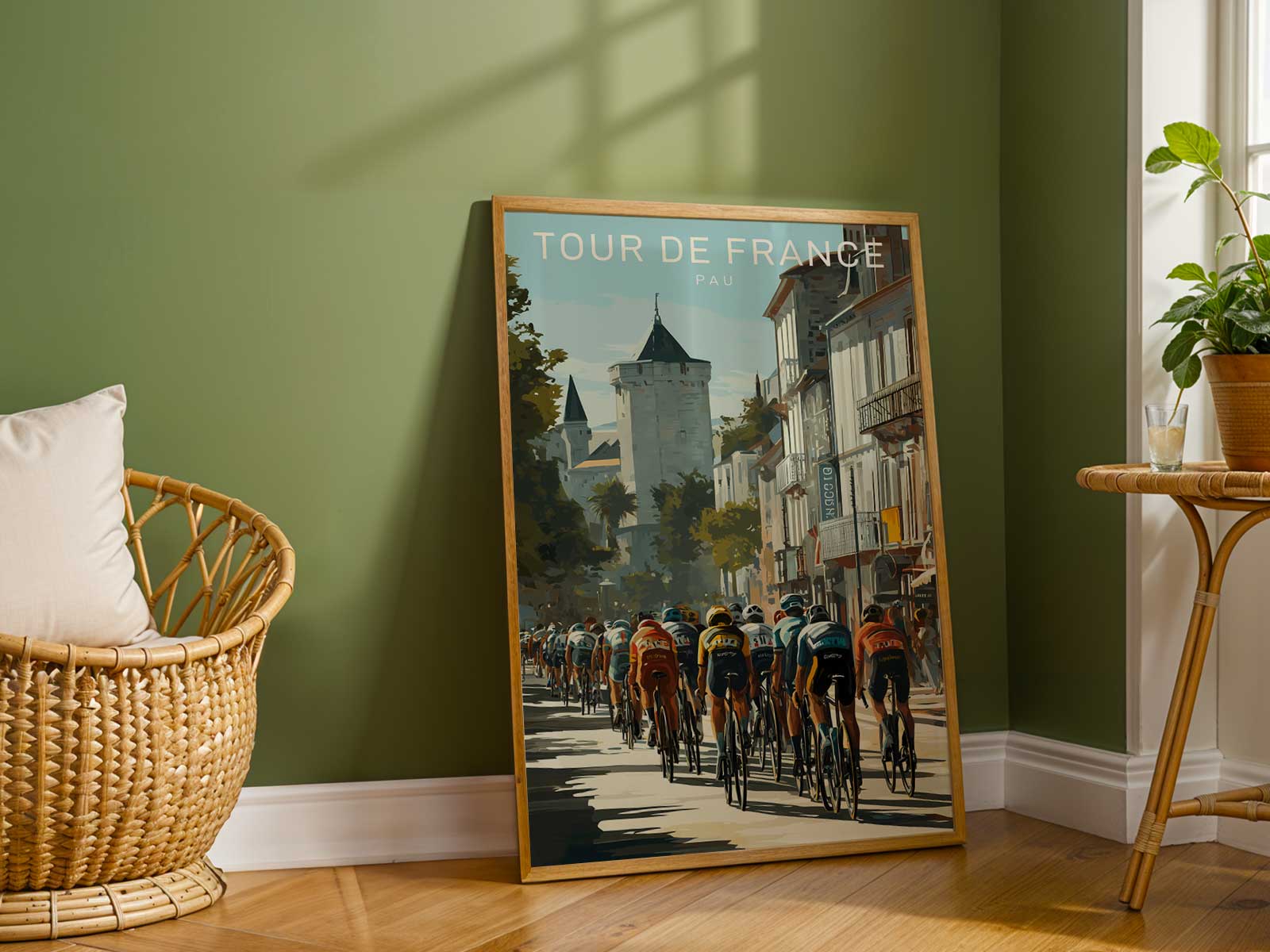
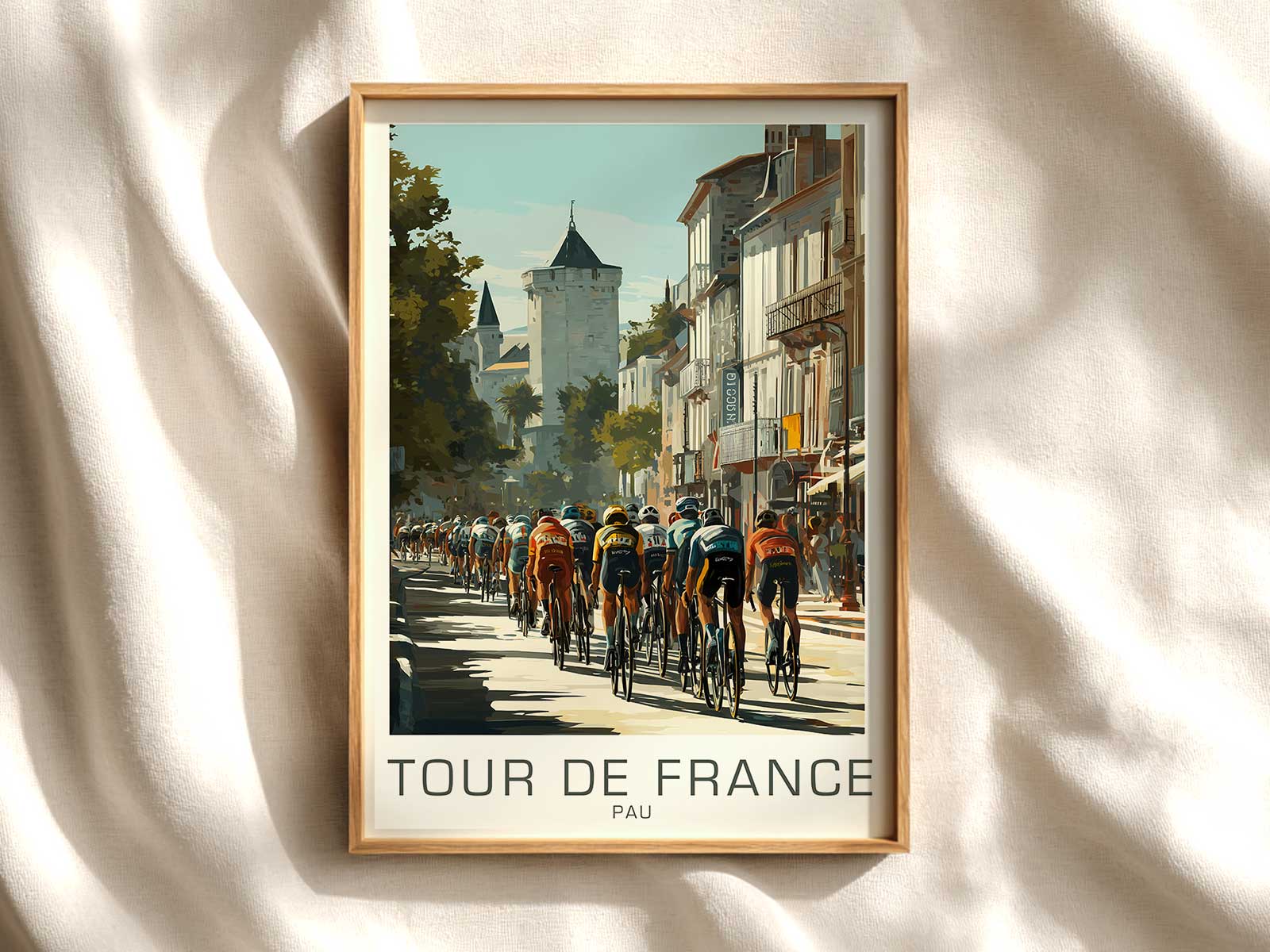
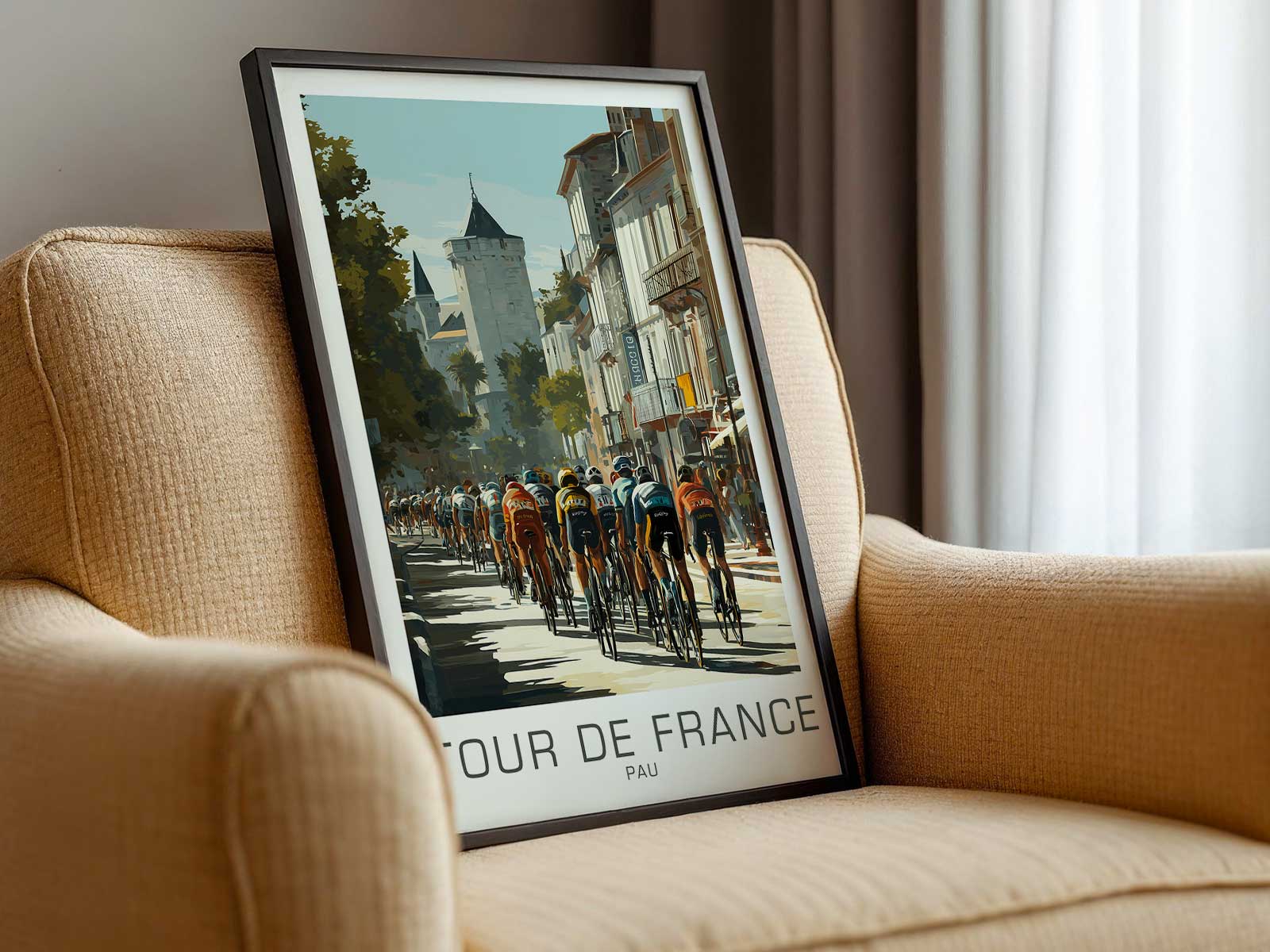
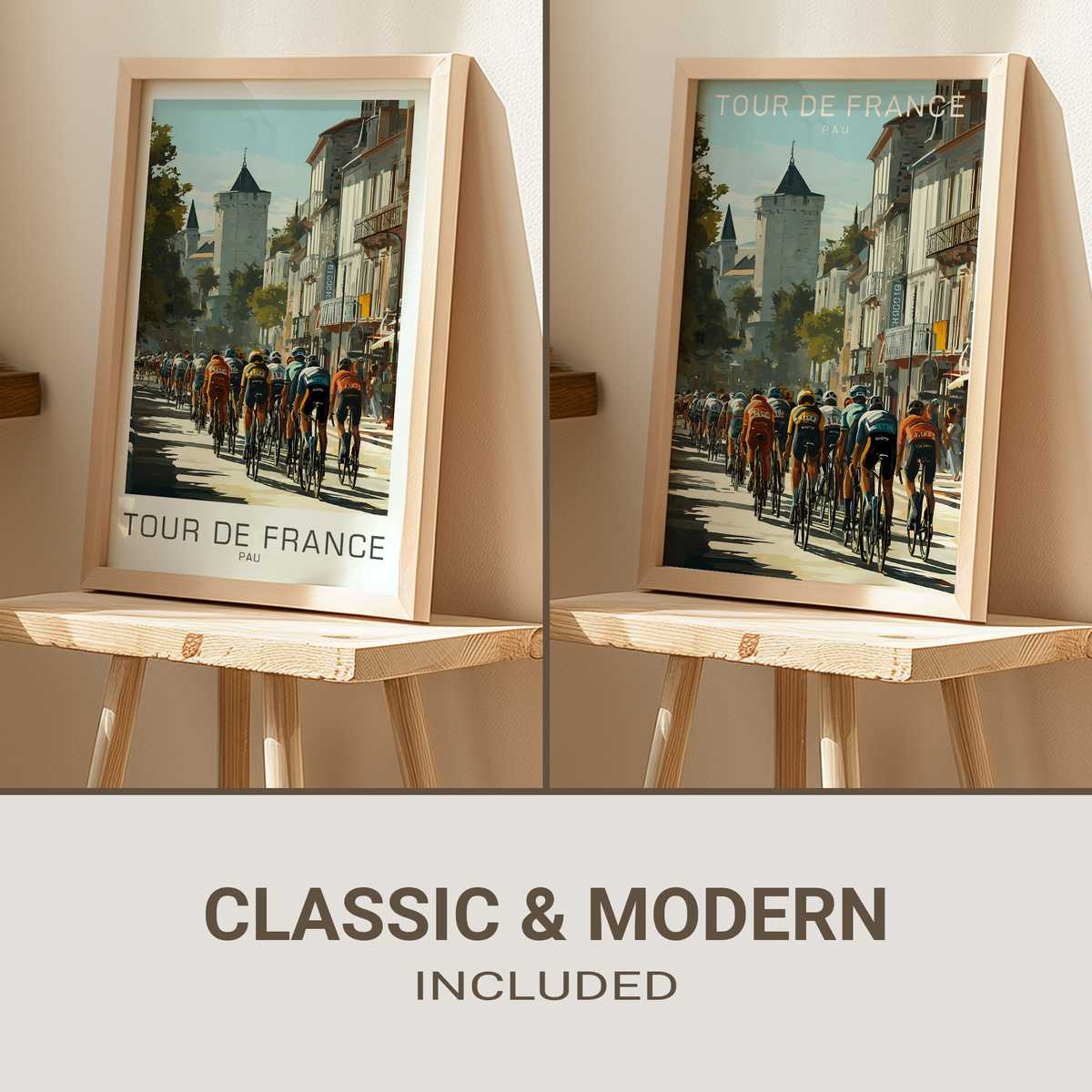
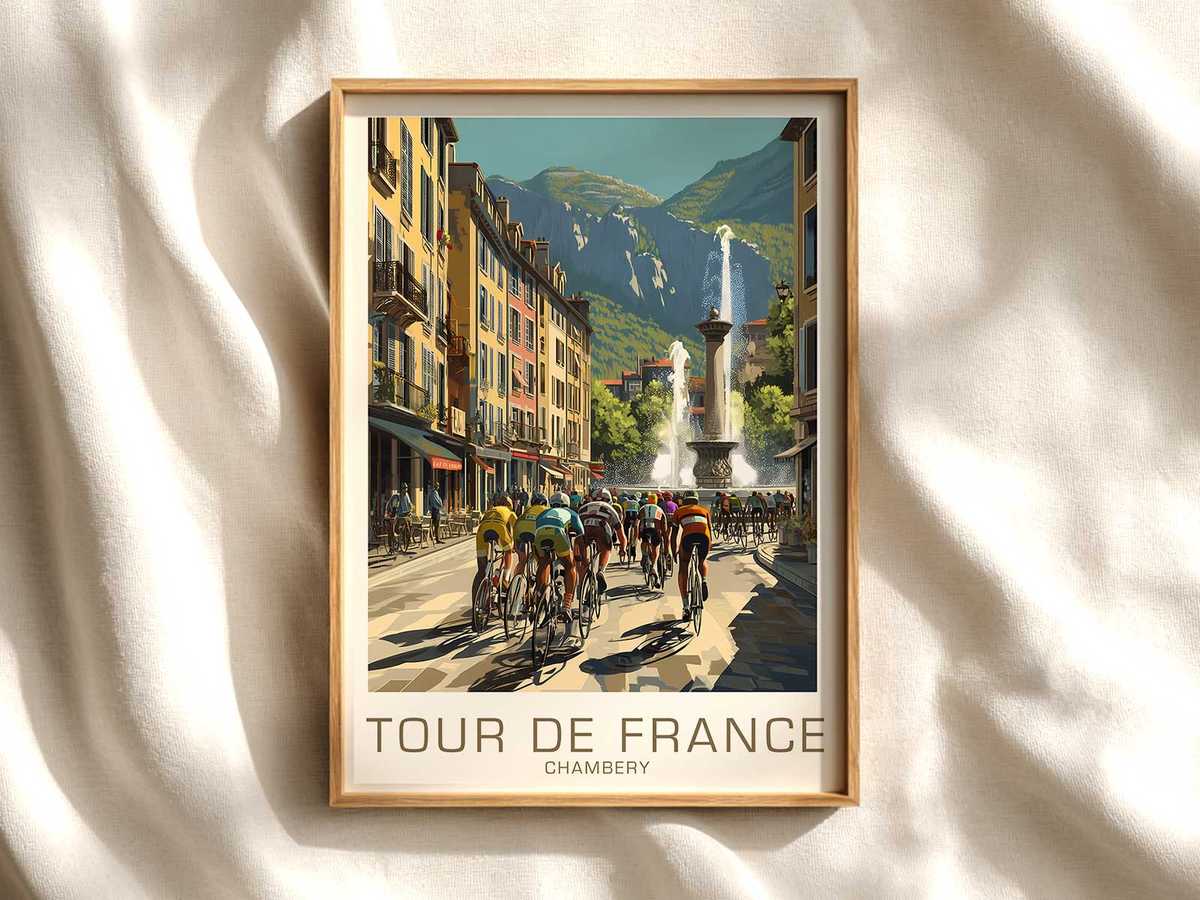
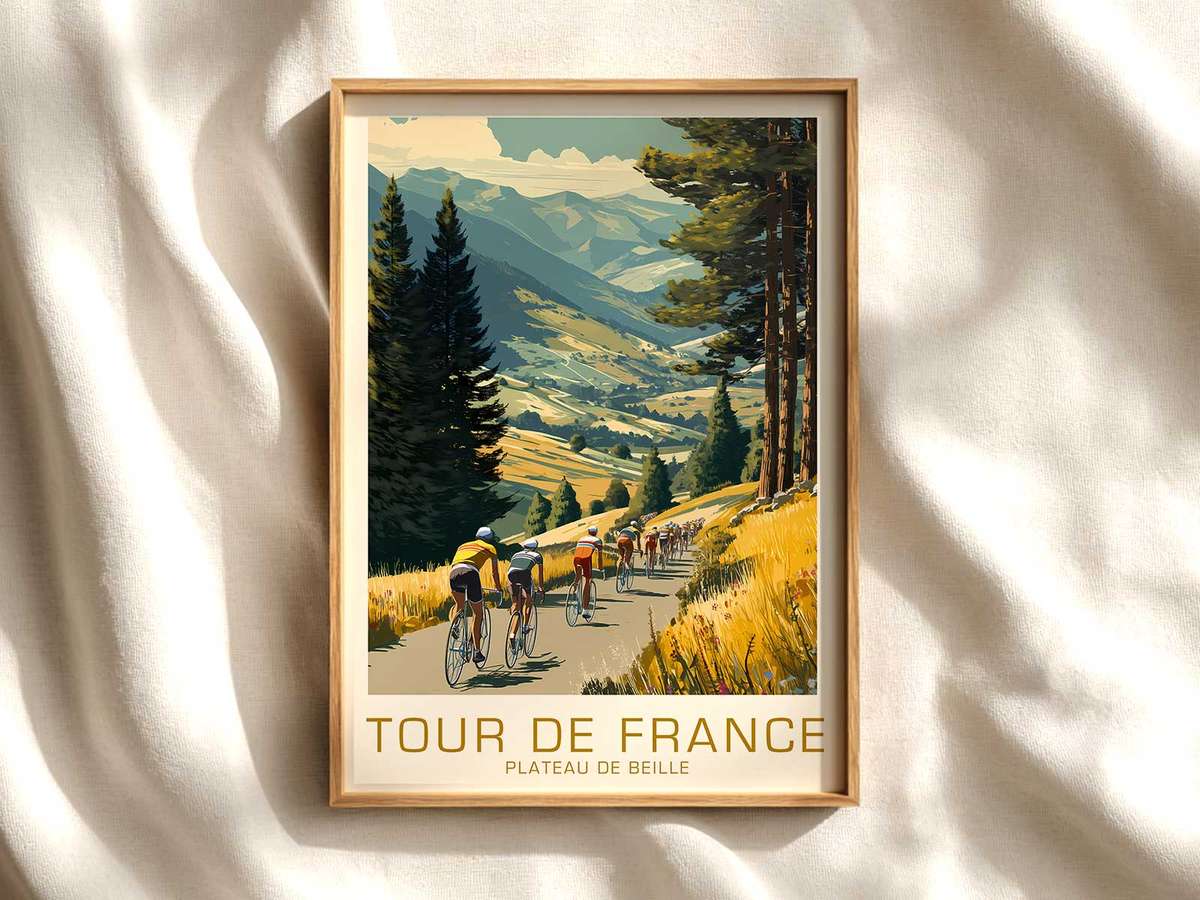
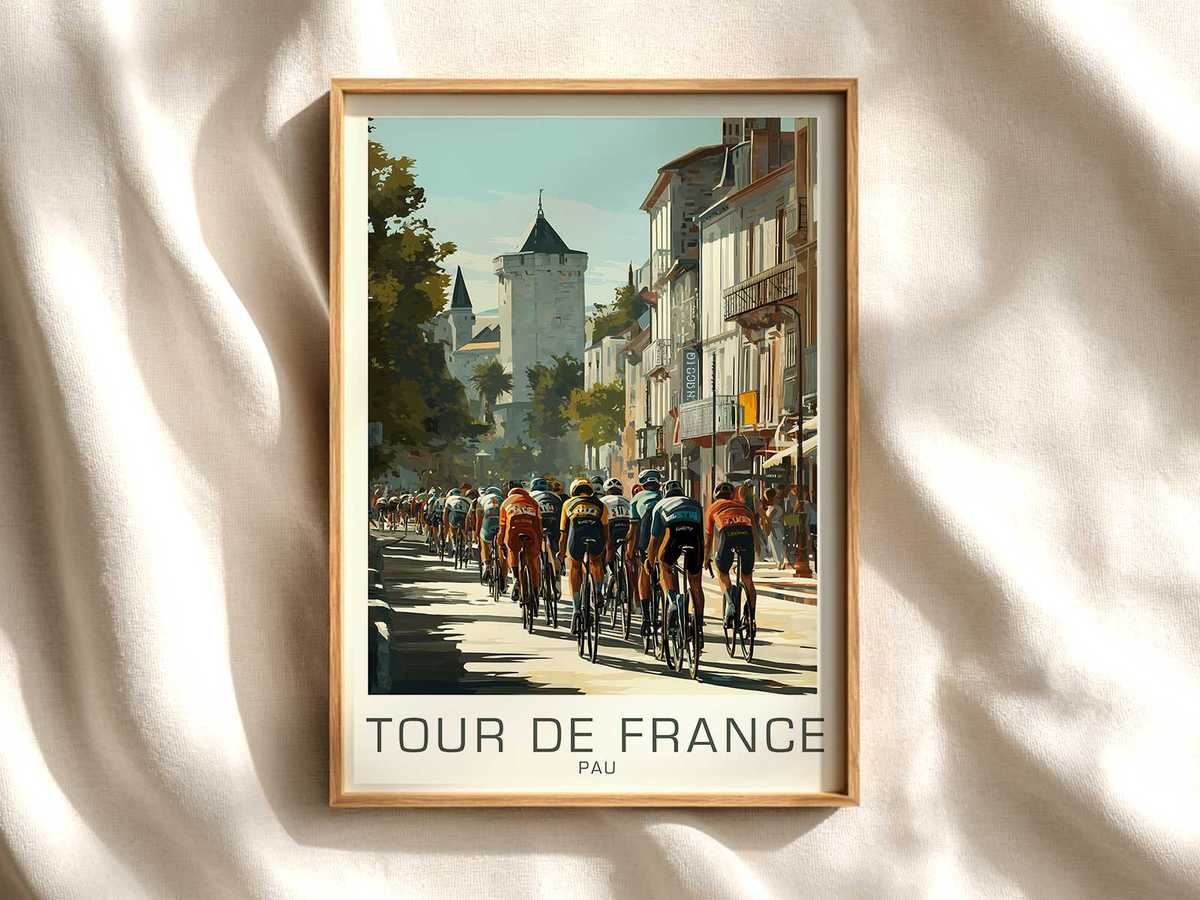
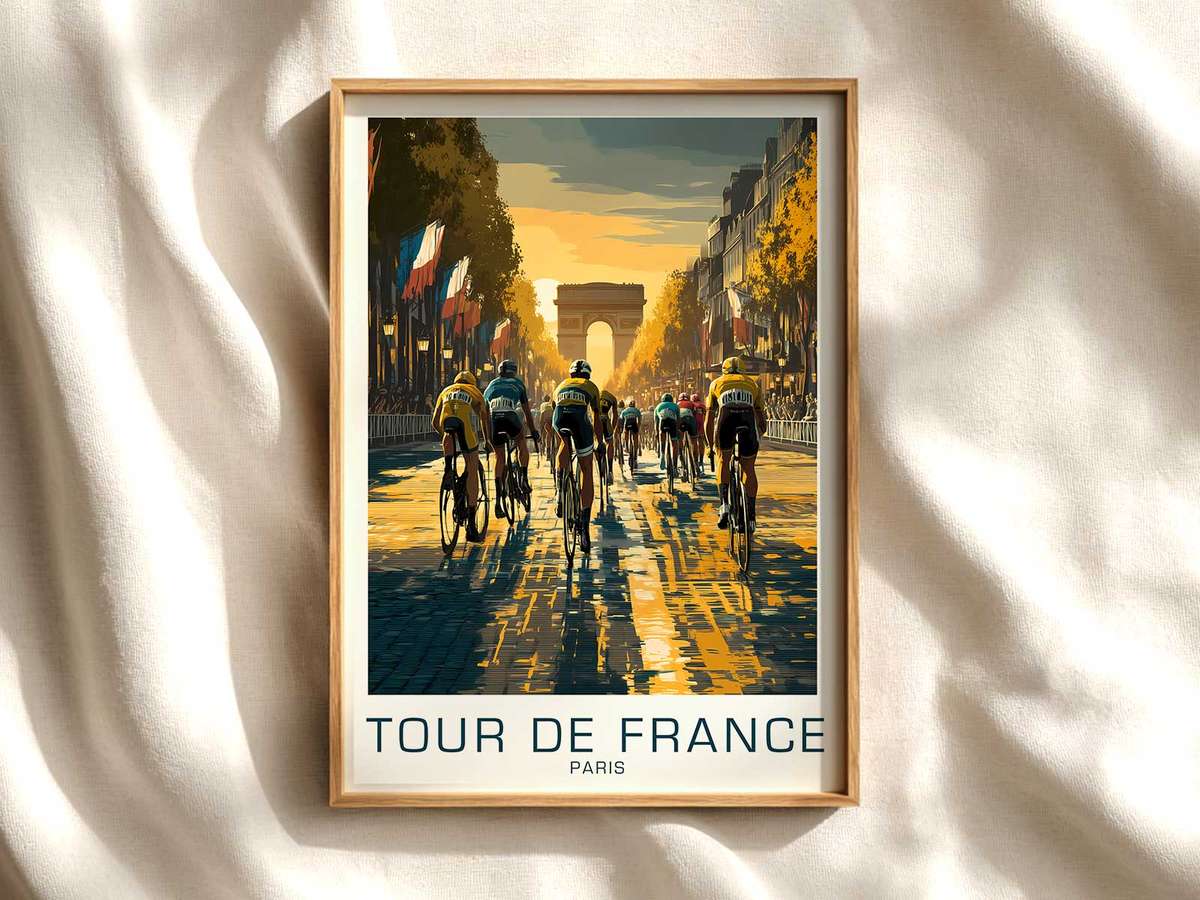
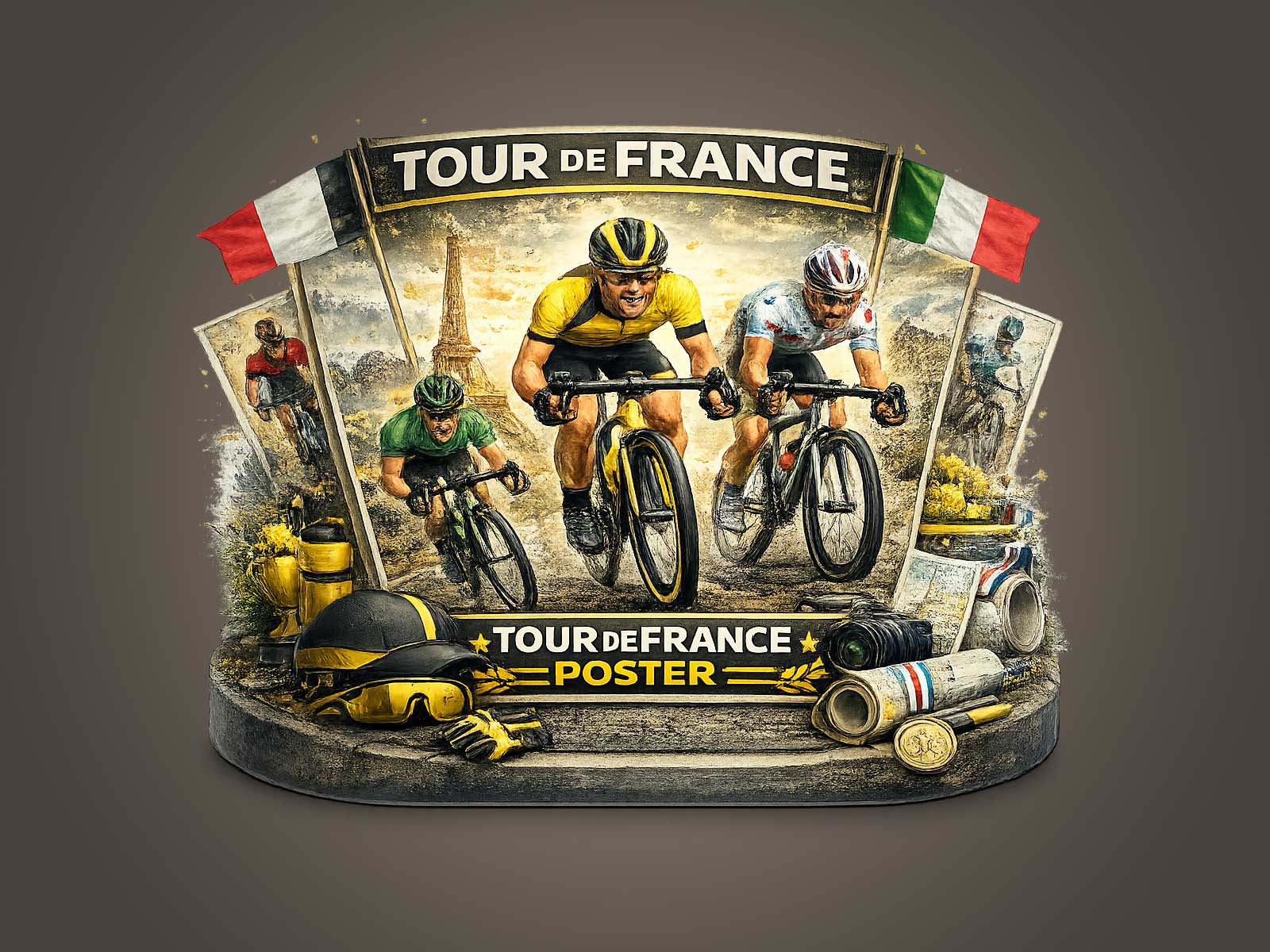
There is a quiet power in a vintage bike race poster tied to Pau: it does more than recall a stage, it reconstructs an atmosphere. The composition—weathered paper, muted inks, and a silhouette of an older racing bicycle—reads like a fragment of cultural memory. Local landmarks and the soft geometry of mountain contours anchor the scene, but what makes the image move beyond illustration is its dialogue with history: a visual vocabulary where regional pride, the lived reality of racing, and the tactile evidence of print-age craft answer one another naturally.
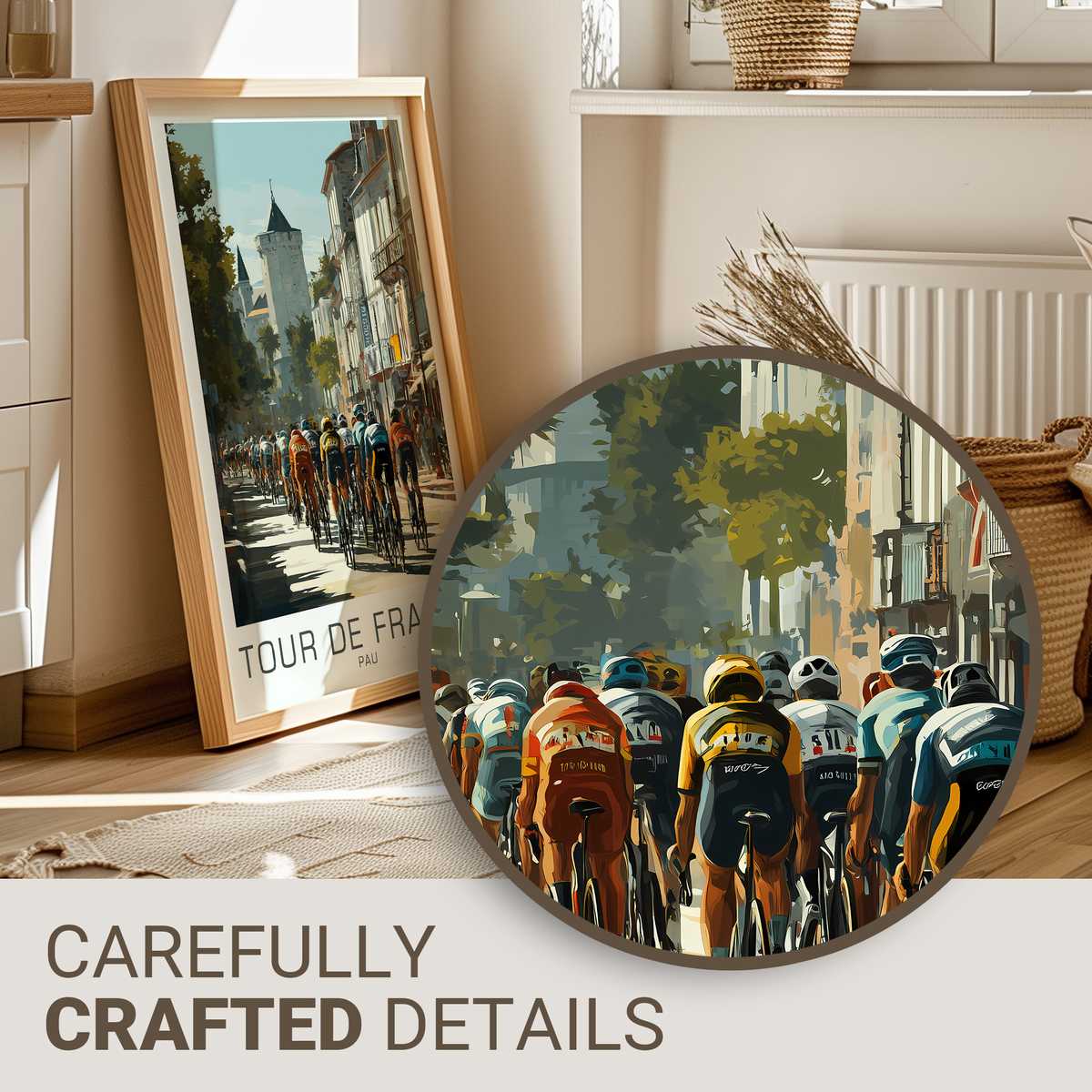
Viewed as wall art, this poster performs several roles at once. It is documentary without being didactic; decorative without being superficial. The patina of age—slight yellowing at the edges, subtle ink bleed, and the suggestion of hand-set type—signals an object that has been handled in time. Those signs invite a different kind of looking than a modern promotional poster: the eye slows, seeking detail in classic jerseys, the curve of a steel frame, and the discreet presence of town names. That slowness is precisely the heritage value. It makes the piece feel like a recovered memory, not a manufactured trend.
Archival aesthetics are central to why such images resonate. A restrained palette, the mechanical grain of offset printing, and compositional choices that prioritise silhouette and place over flashy effects produce an aesthetic of endurance. The jerseys are rendered as emblematic shapes rather than ephemeral fashion, the bicycles as precise objects whose geometry speaks to an older engineering logic. Even without specific historical claims, these visual cues read as authenticity: the poster becomes a proof of connection to a cycling continuum stretching through riders, roads, and local cafés.
[IMAGE_INSERT_ARTICLE_01]
Heritage here is not simply nostalgia. It is an argument about meaning: that sporting life is embedded in landscape and community. The image of Pau—its roofs, its slopes, the suggestion of a riverside lane—carries civic memory. For collectors and interior designers, that civic specificity transforms the poster into a conversation piece. In a study or library it suggests stories worth telling; in a studio it implies a cultivated sensibility; in a living room it brings warmth and provenance. This is why such posters feel more rooted than decorative retro: they put place and practice at the centre of their appeal.
The cultural depth of older Tour imagery also comes from its iconography. Classic bicycles and period jerseys are shorthand for an era of endurance and tactile experience. They conjure the sounds of tubulars on cobbles, the smell of chain oil, the hush of a small town watching a peloton pass. That conjuring is visually economical: a single emblem—a striped collar or a leather saddle—can recalibrate how a room feels. A heritage poster, then, functions like a relic: it reactivates sensory memory without needing to narrate history explicitly.
Finally, the collector appeal of this kind of poster rests on its dual identity as art and artifact. It occupies the space between printmaking craft and lived event. For those arranging interiors around thoughtfulness rather than trend, such an image offers depth: texture that rewards proximity, iconography that rewards familiarity, and a local specificity that rewards curiosity. Placed on a wall, a Pau-linked vintage bike race poster becomes less about cycling fandom and more about continuity—an invitation to remember, to display, and to belong to a story that extends beyond the frame.
Author: