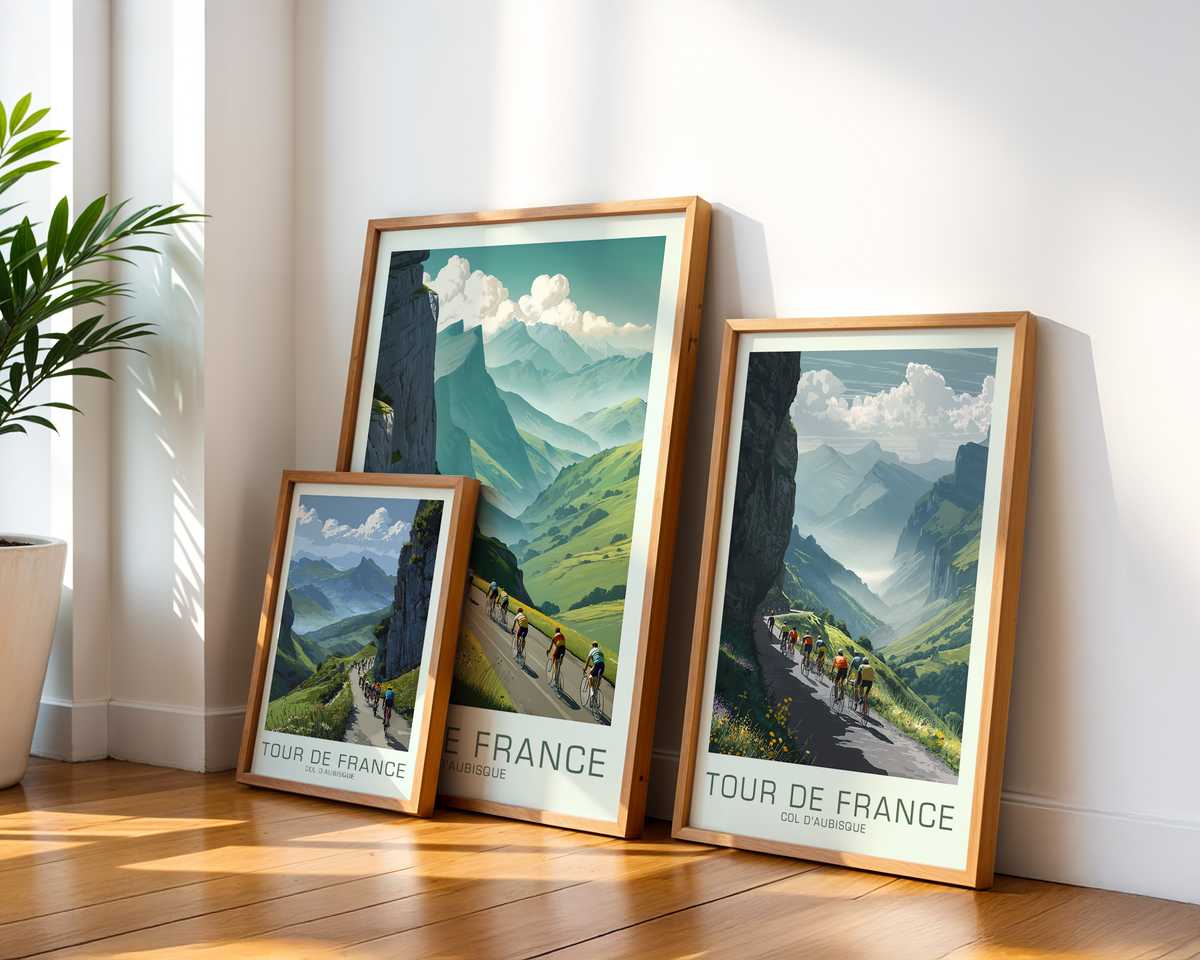
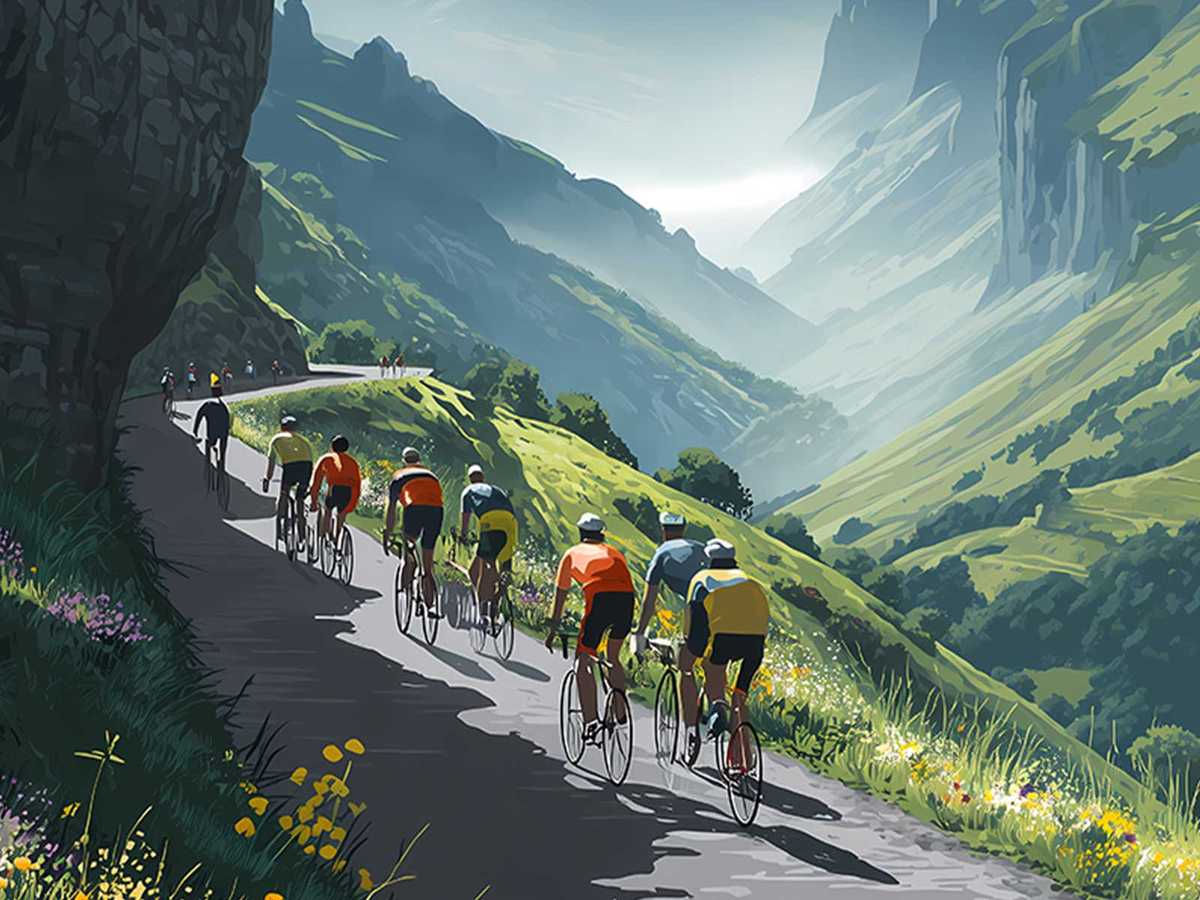
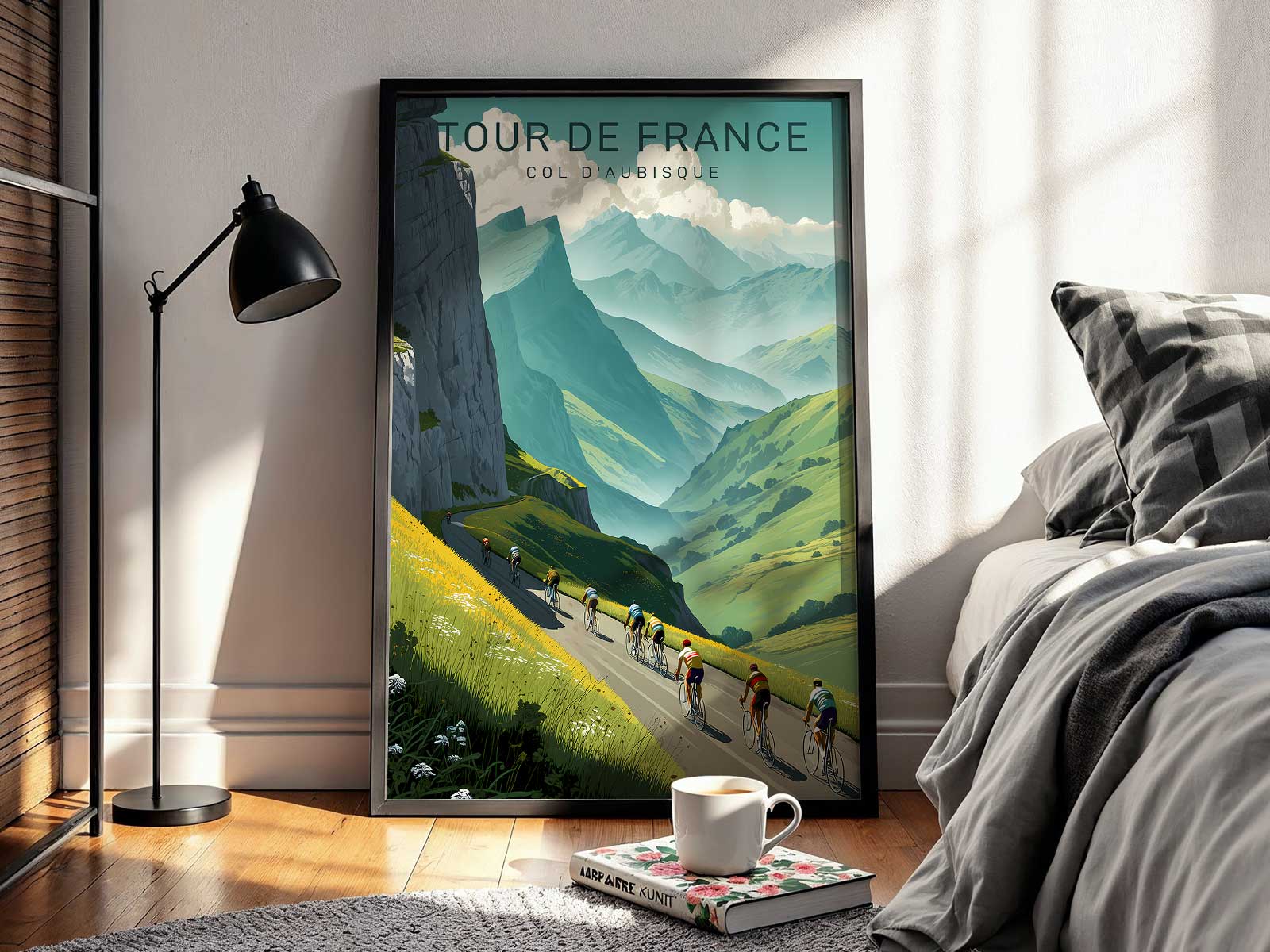
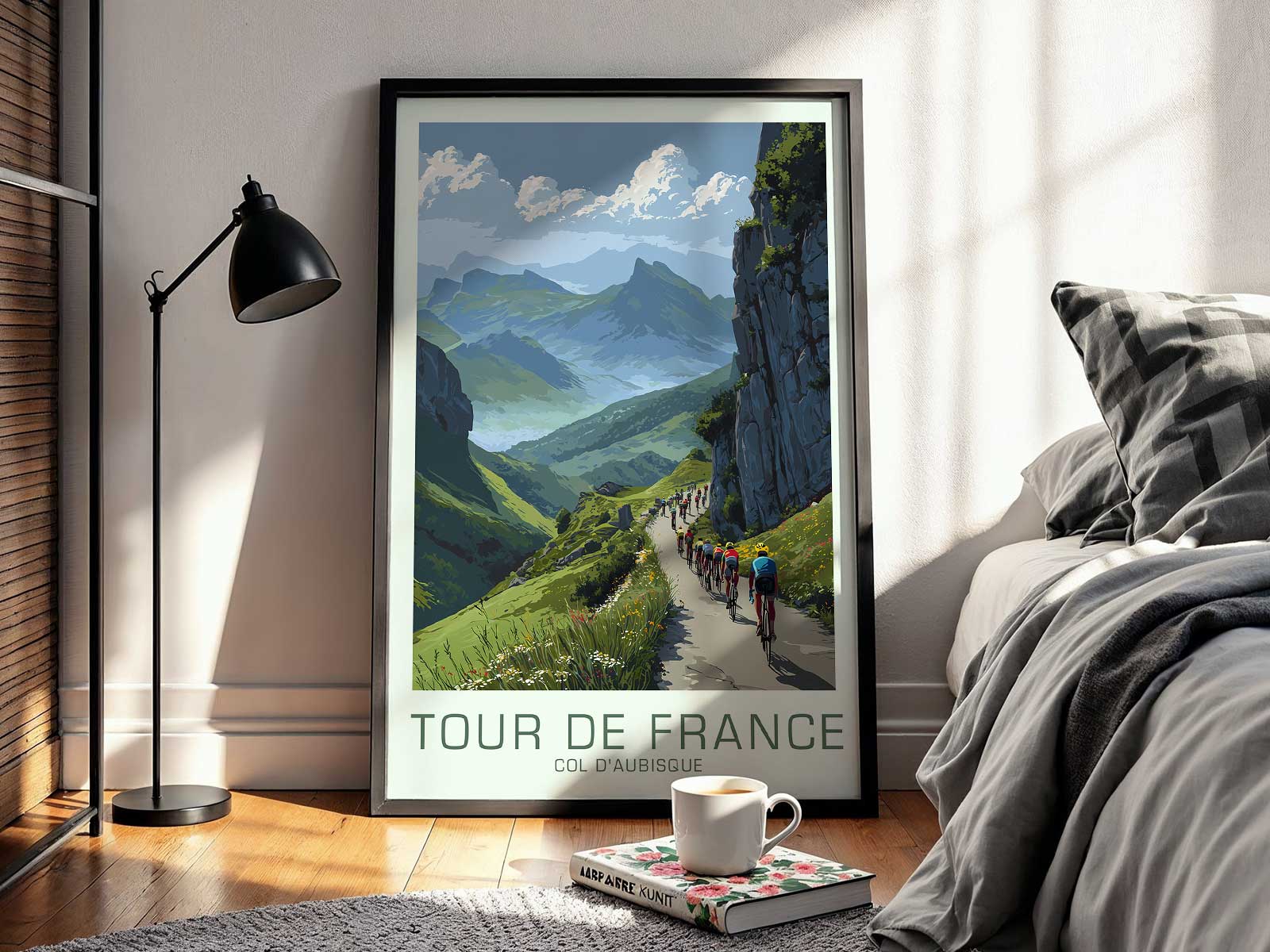
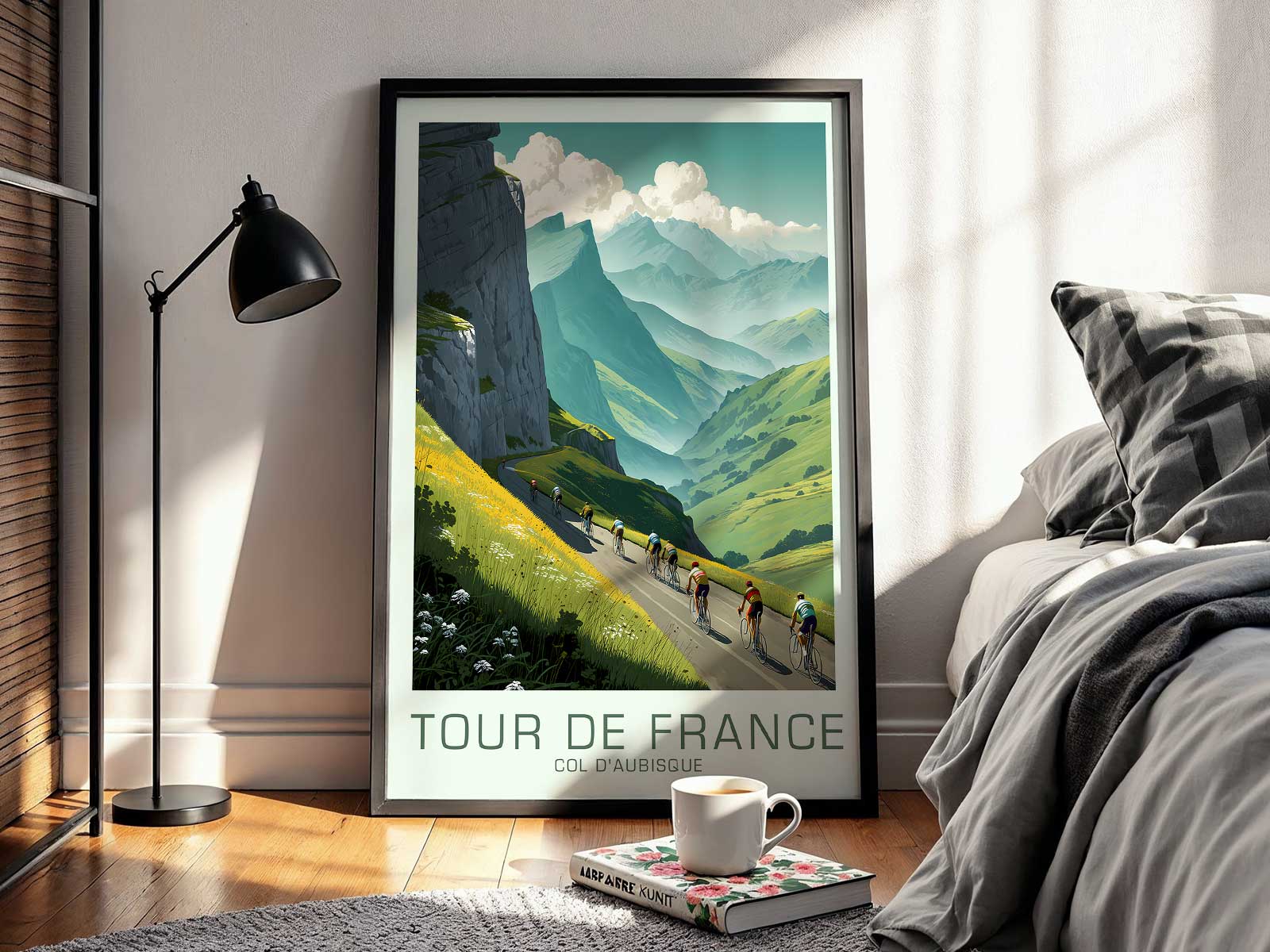
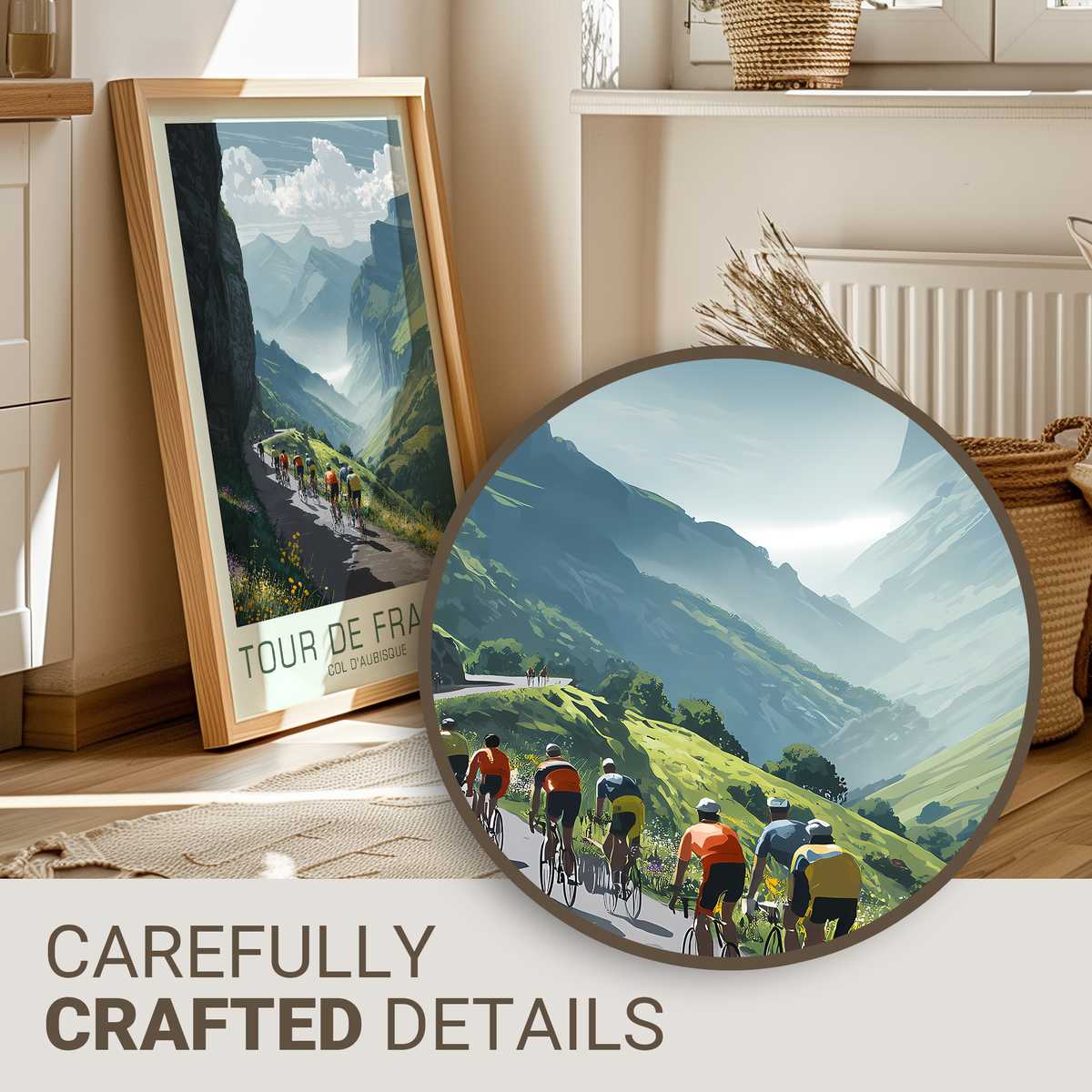
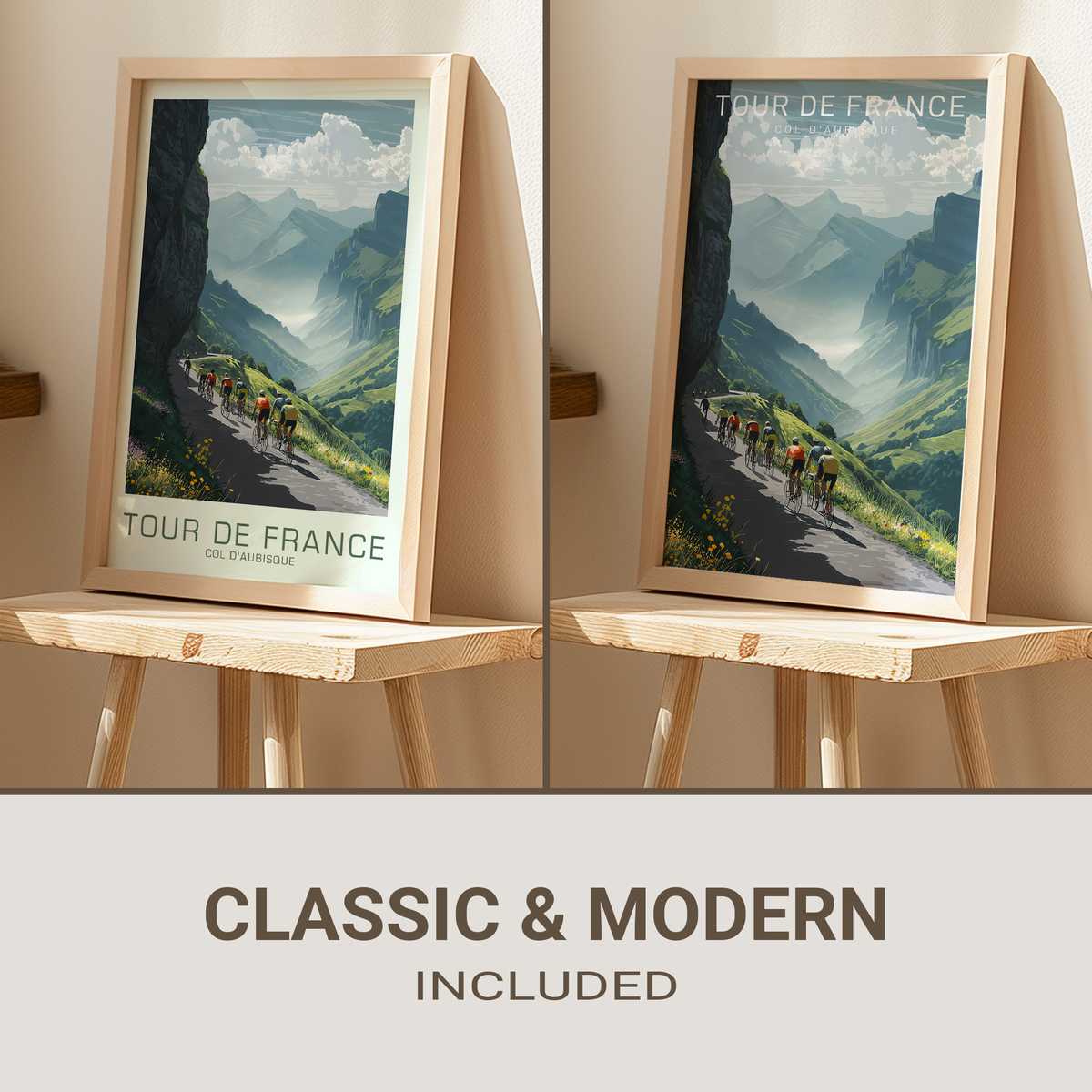
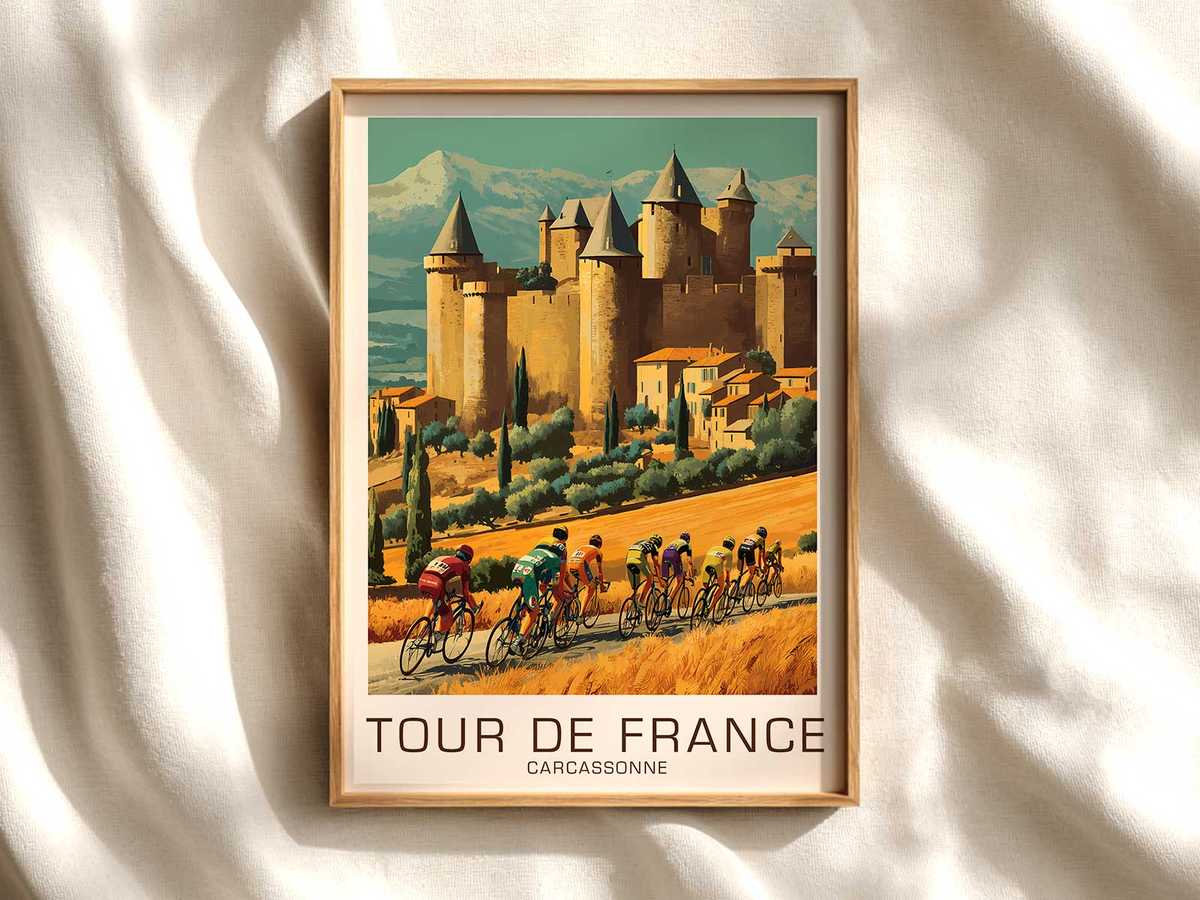
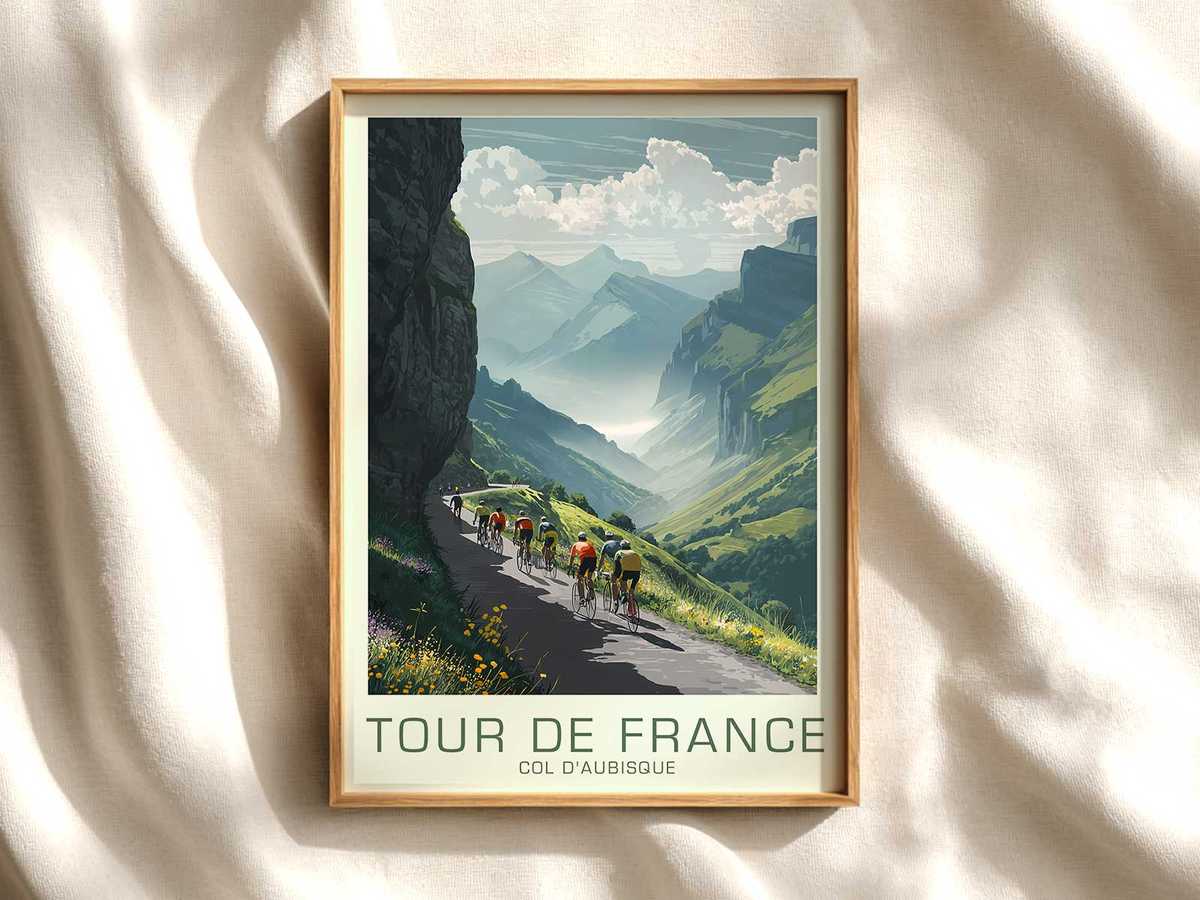
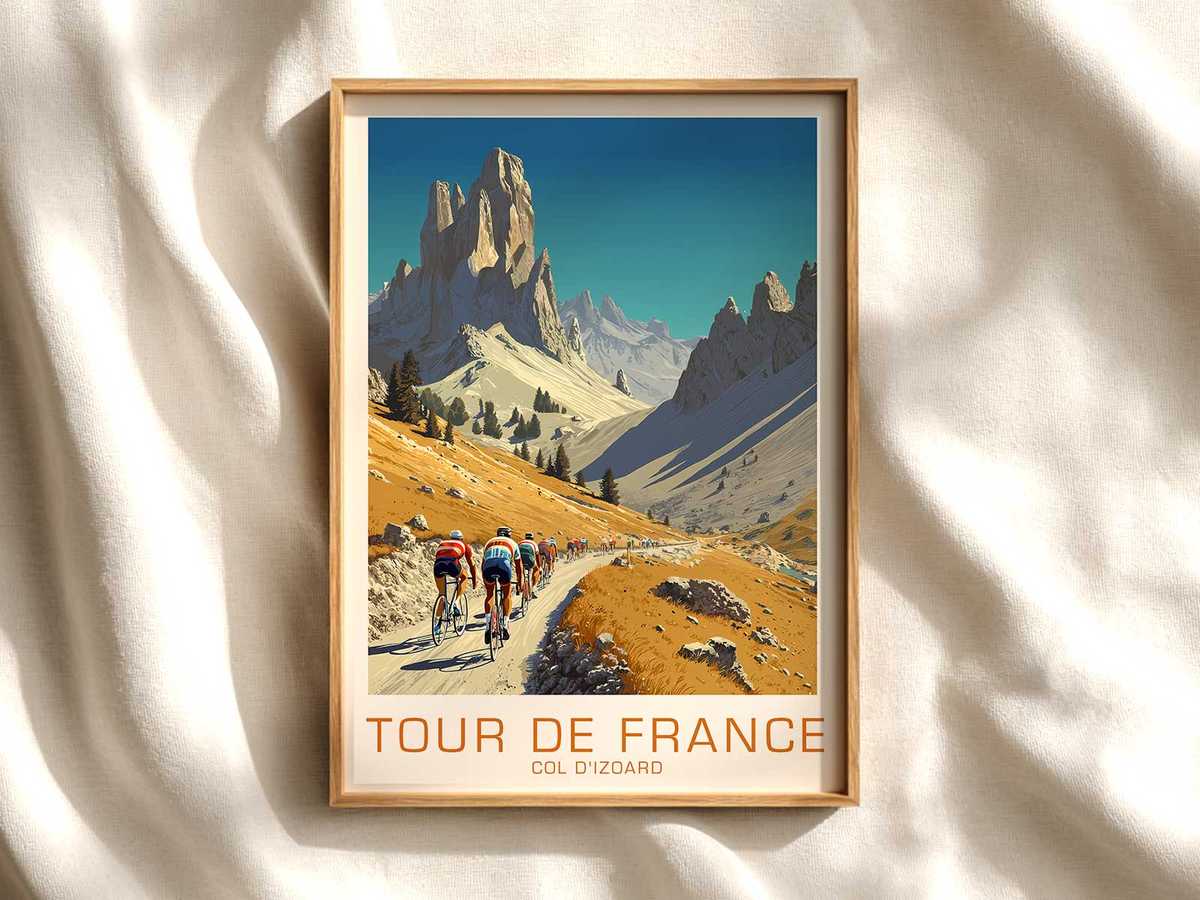
The Col d’Aubisque is less a single place than a sensation: a ribbon of road clinging to steep folds of rock, a sudden opening of high pasture and scree, and the thin, crystalline air that makes every pedal stroke feel like a small, decisive act. A well-made retro Tour de France poster of this climb does not merely depict geography; it translates slope, light and the human measure of effort into a visual narrative that reads as drama at first glance. The image asks the viewer to remember ascent—its rhythm, its strain, and its eventual solitude—so the wall becomes a stage for the imagination rather than a decorative afterthought.
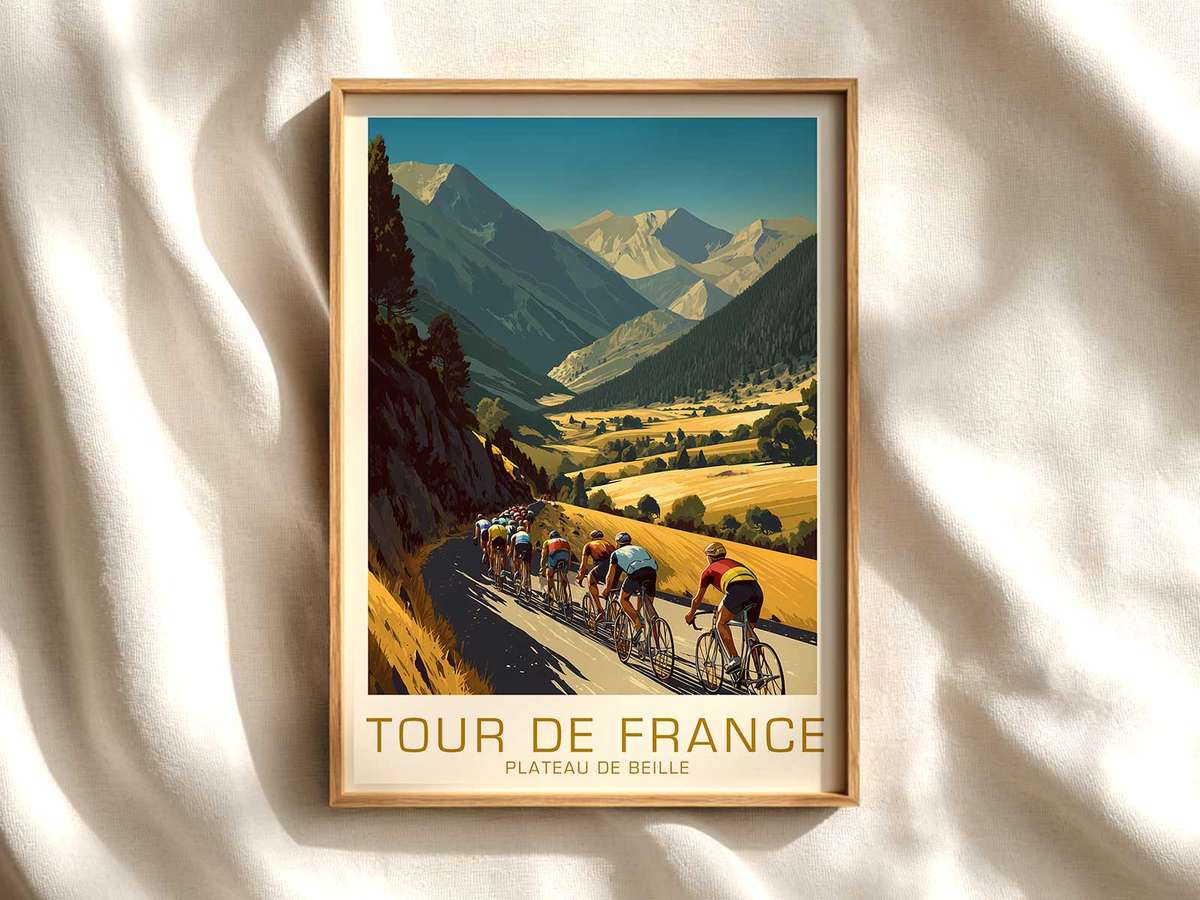
In print, the road itself becomes the protagonist. A curving ribbon of tarmac, eased into the composition with careful negative space, suggests gradient without arithmetic: the eye follows the bend and senses the angle. Narrow lanes framed by rough stone, hairpins that tighten into cliffs, and the intermittent presence of guardrails or cairns all read as shorthand for sustained climb. In a retro style, simplified shapes and restrained palettes strip away distraction, leaving only the essential geometry of ascent. That economy of form makes the slope feel longer; the viewer's gaze and their breath both elongate along the line of the road.
Light is the second language of altitude in these posters. High-mountain luminosity—sharp, cool, and slightly unforgiving—can be rendered as silvery highlights on rock faces and a cooler background haze that suggests distance. Shadows fall hard and define texture: scree flats, limestone ribs, the sparse needles of high pines. When poster art leans into a late-afternoon glow, it adds a cinematic warmth, hinting at fatigue and the golden end of a long day. That interplay of cool and warm tones creates an emotional topography that mirrors the physiological arc of a stage: beginning, sustained effort, the reward of view, and the melancholy of leaving the summit behind.
[IMAGE_INSERT_ARTICLE_01]
Villages and roadside gatherings in the composition give human scale to the mountain. A tiny hamlet set against the slope, spectators gathered at a bend, and a lone farmhouse roof barely visible in the fold of the valley anchor the heroic geography to everyday life. These details are small, deliberately understated: they suggest a crowd’s hush and the echo of a cheering cluster, rather than showy celebration. In doing so the print preserves a sense of intimacy—the Tour temporarily consecrates these places, and the poster preserves that consecration as a moment frozen in pigment and paper.
The atmospheric texture of such a poster—grain, limited palette, and stylised contours—echoes the endurance at the heart of the climb. Like a well-composed chorus in music, repetition of certain visual motifs, such as recurring bends or layered ridgelines, conveys prolonged effort. The viewer feels the cadence: the surge up a slope, a brief plateau to catch breath, then the next attack. That measured repetition is what separates a scenic postcard from an epic stage portrait; the former shows a view, the latter recounts an experience.
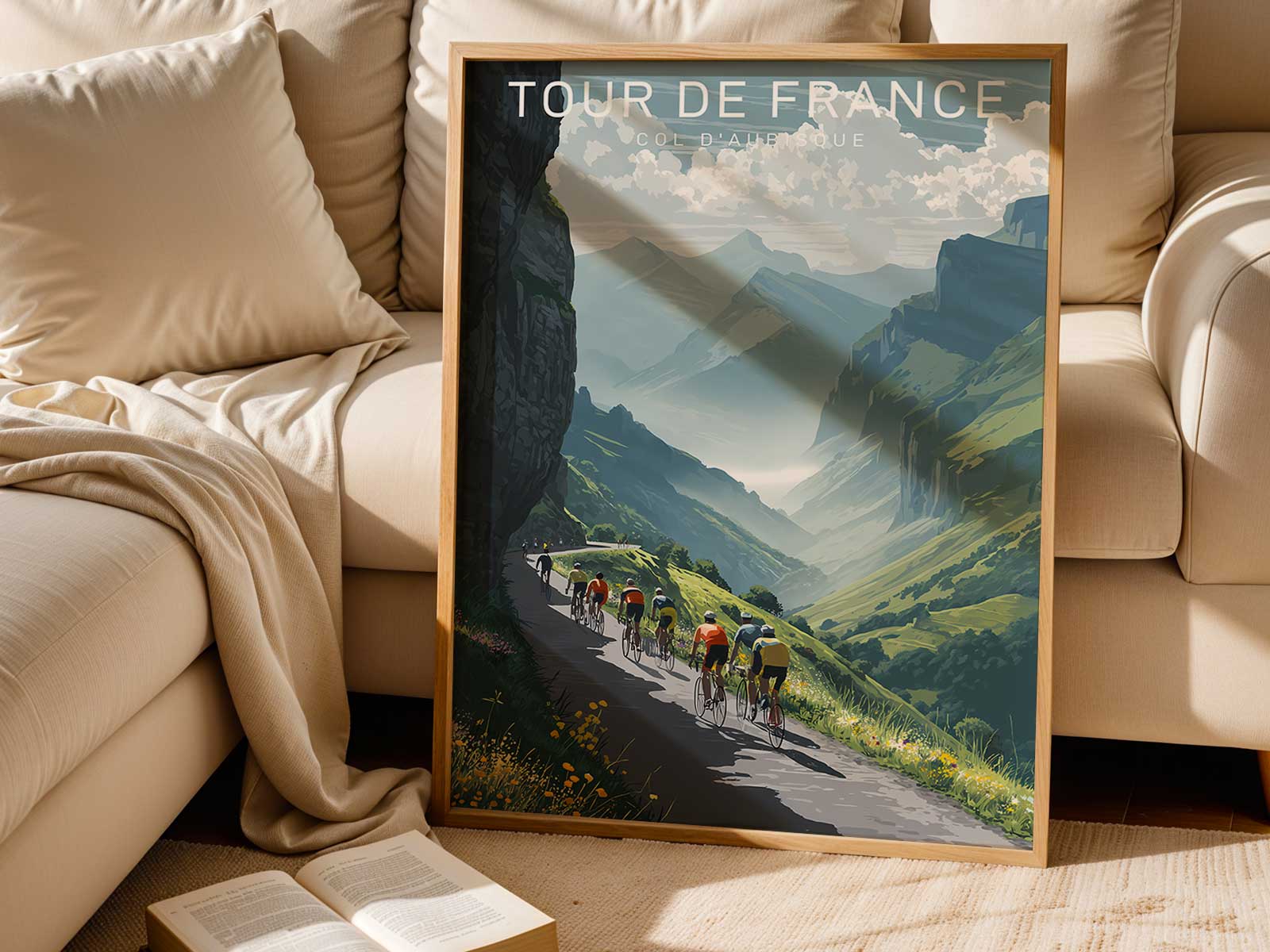
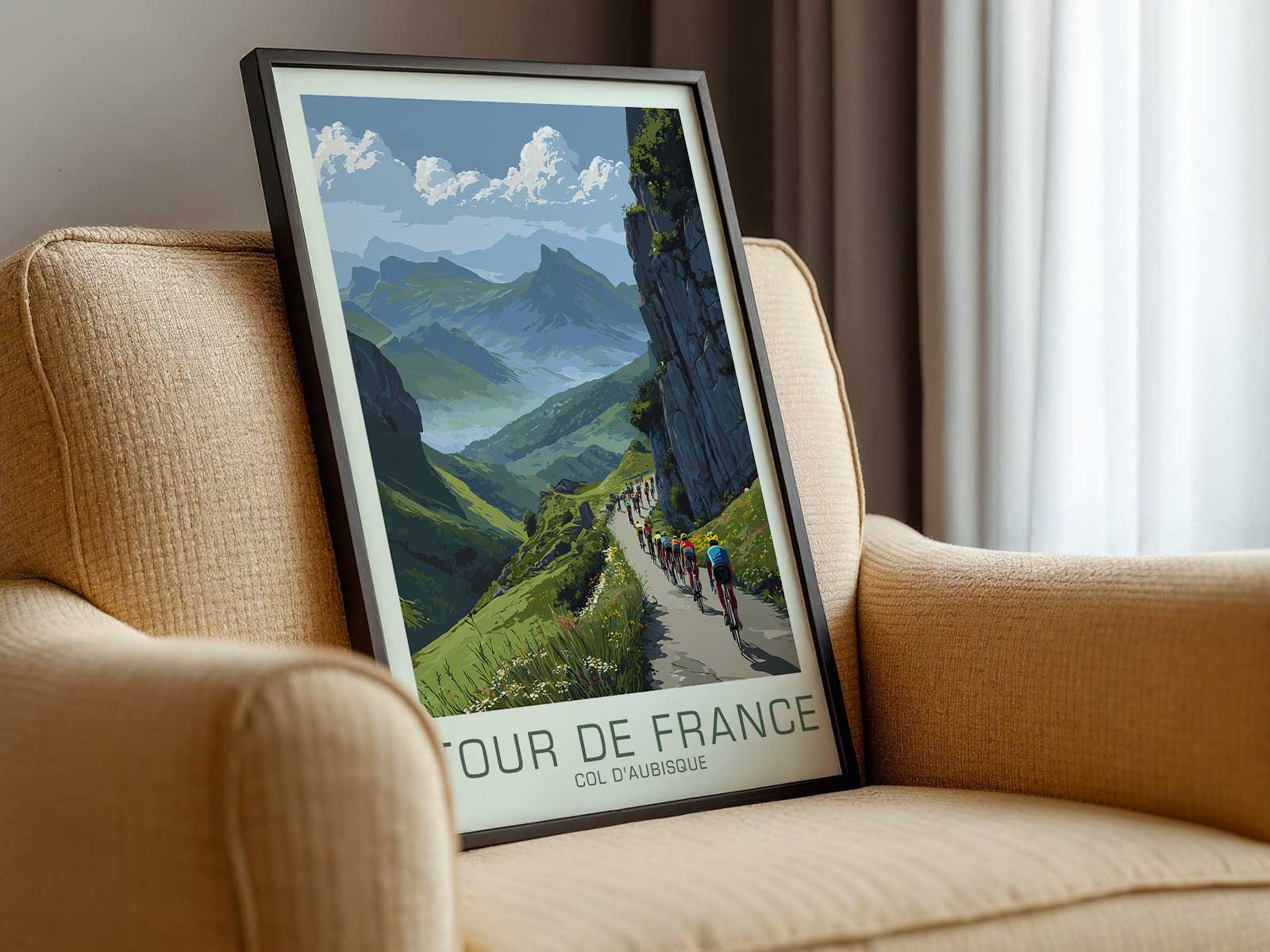
Beyond its narrative force, a Col d’Aubisque poster works exceptionally well as interior art because it alters a room’s mood without overwhelming it. Hung over a desk, in a living room or a studio, it introduces elevation of spirit and a quiet invitation to focus—qualities prized by readers, makers and riders alike. The print’s scale and restrained colorways allow it to play with light in a room: pale areas catch daylight and deepen in the evening, while darker passes anchor furniture and create a visual horizon that expands small spaces.
Finally, stage-led imagery carries memory value for cycling culture. It rewards anyone who knows the climb and intrigues those who do not, offering an entry point into the lore of mountain racing. A retro poster of the Col d’Aubisque does more than celebrate a route; it preserves the mood of a stage—the altitude, the gradient, the communal hush of spectators and the solitary calculus of effort—and turns it into an object that keeps that drama alive on your wall.