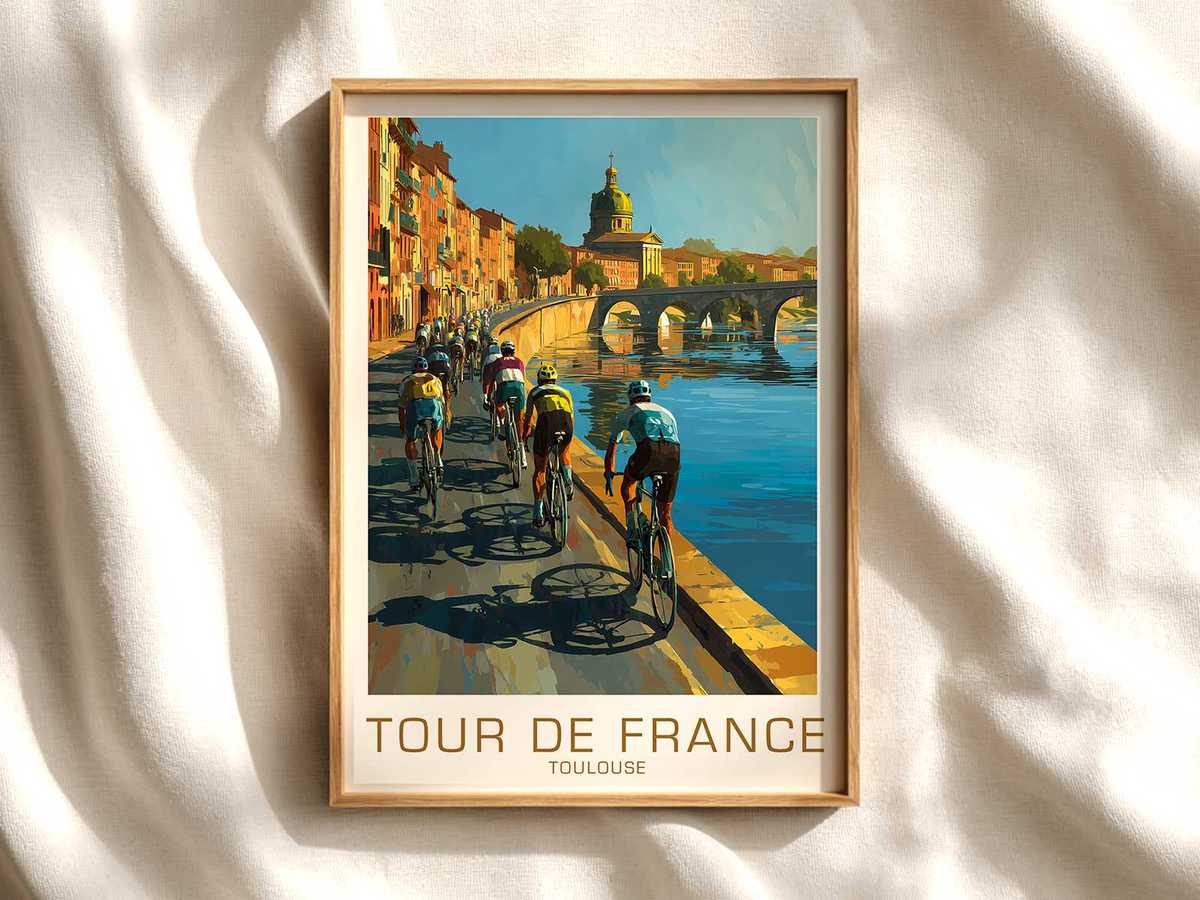
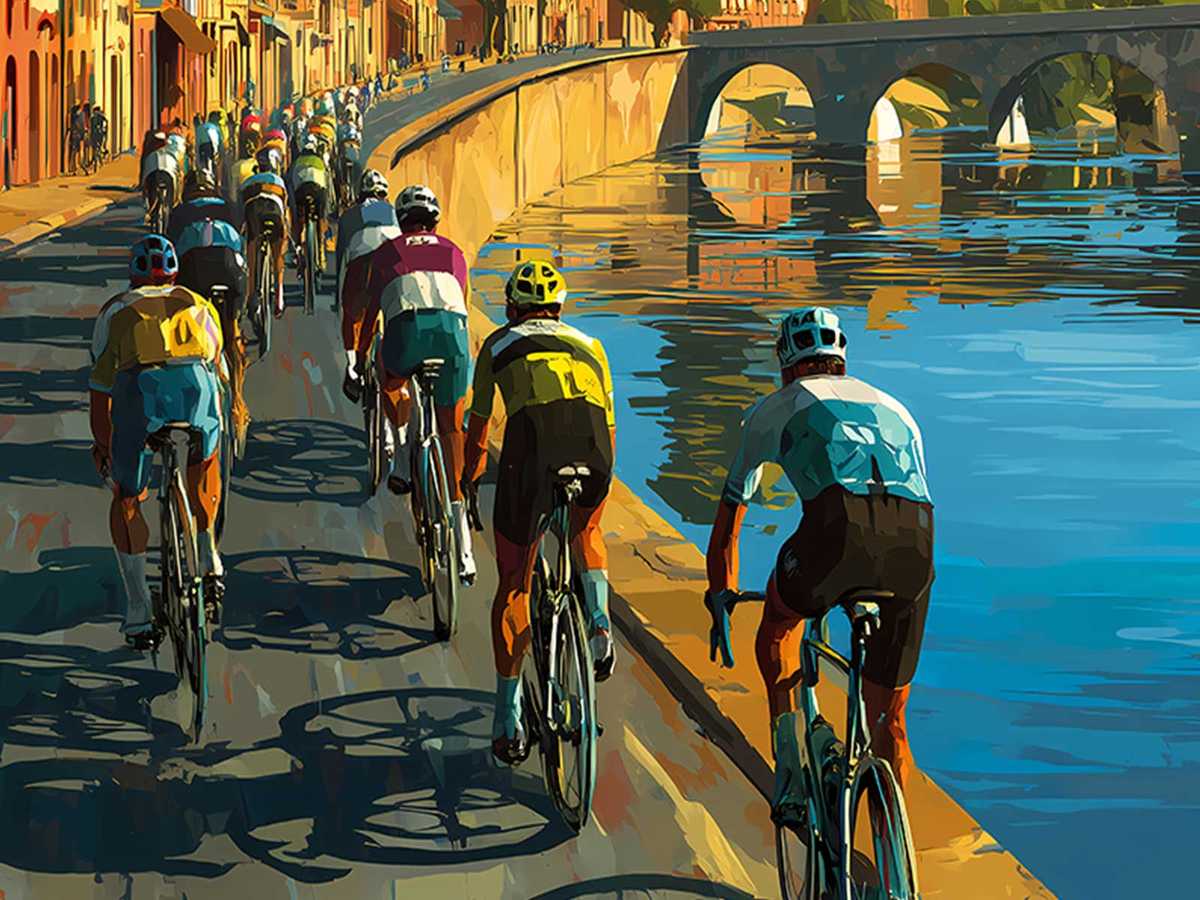
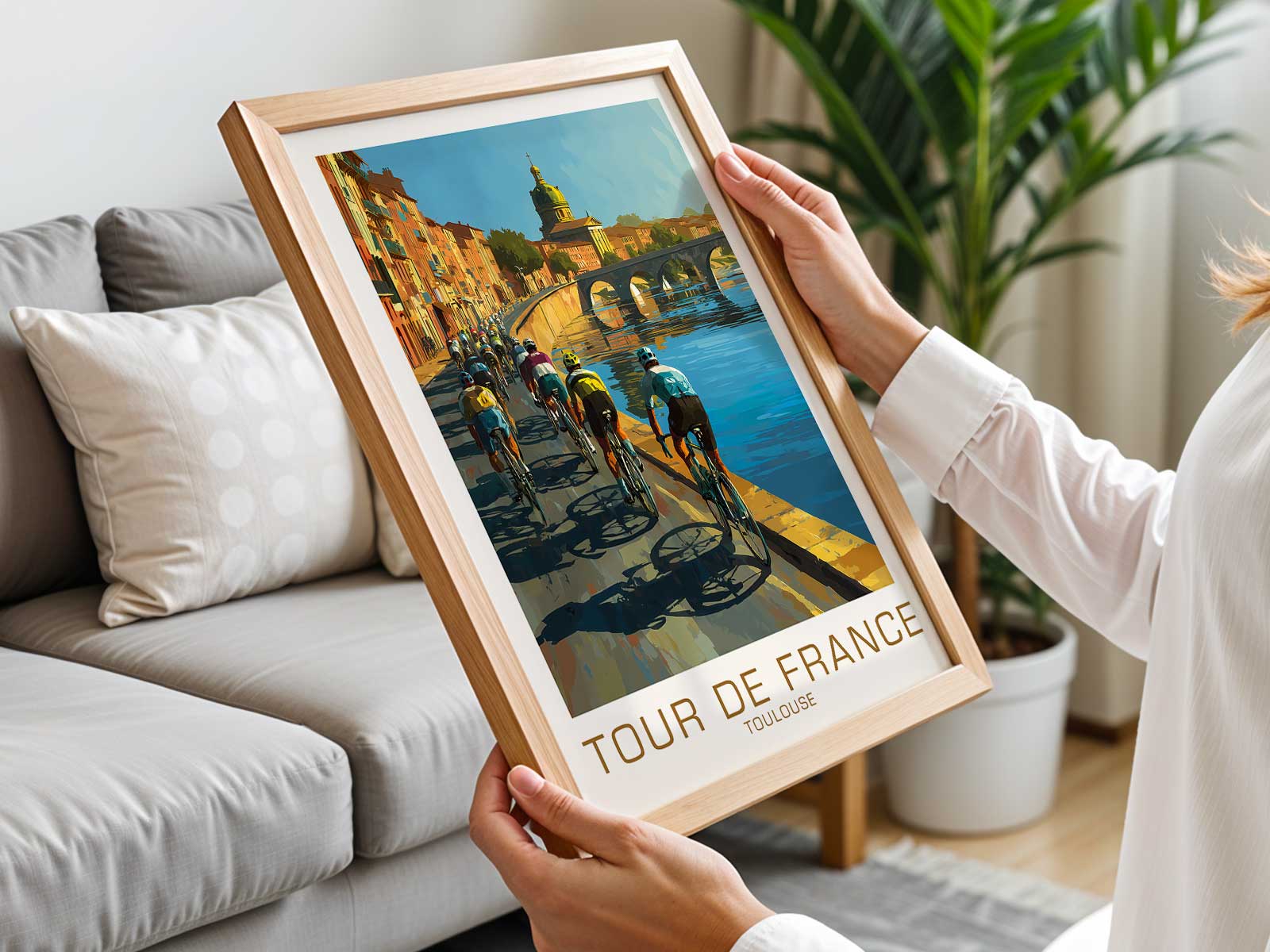
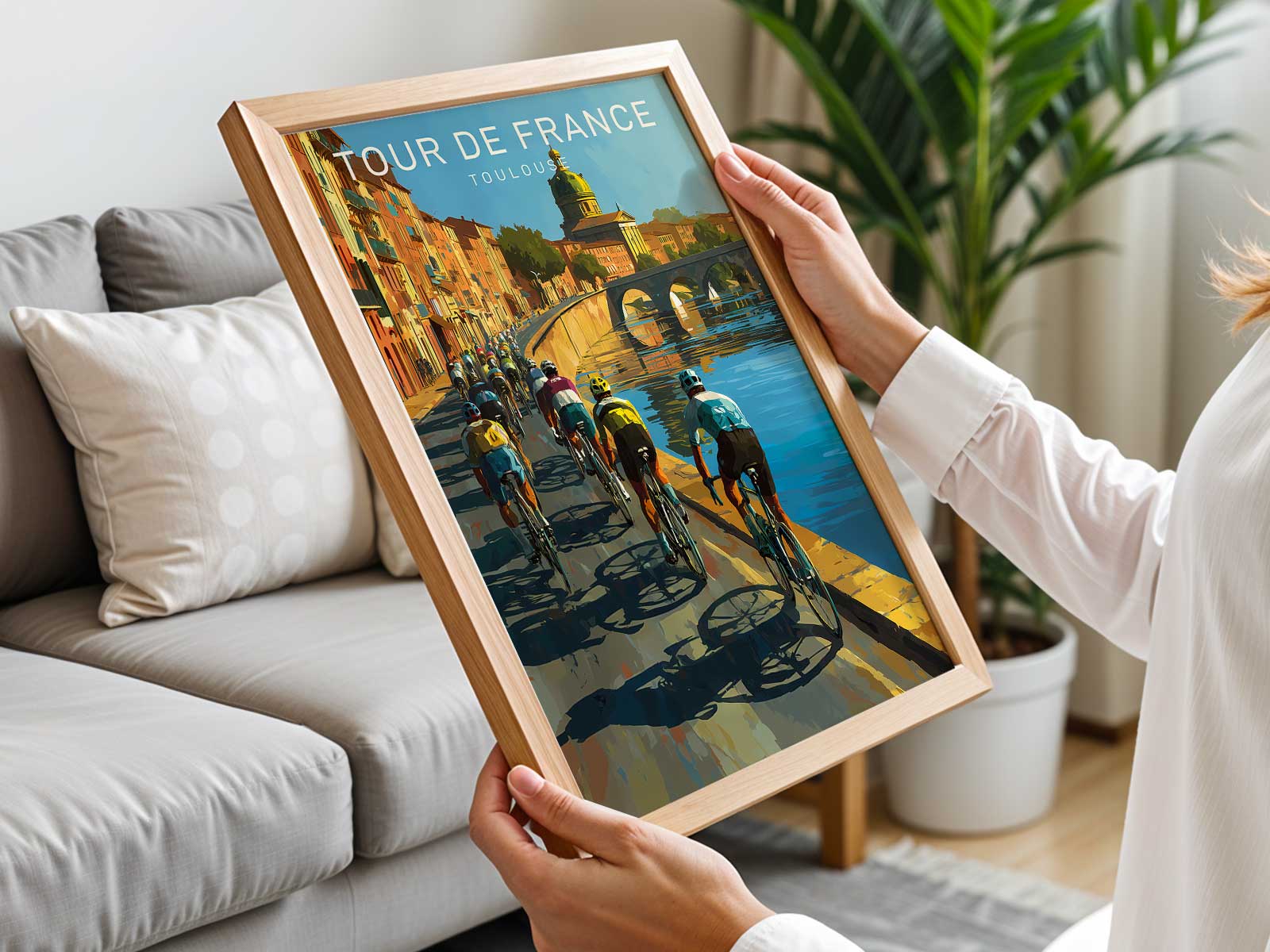
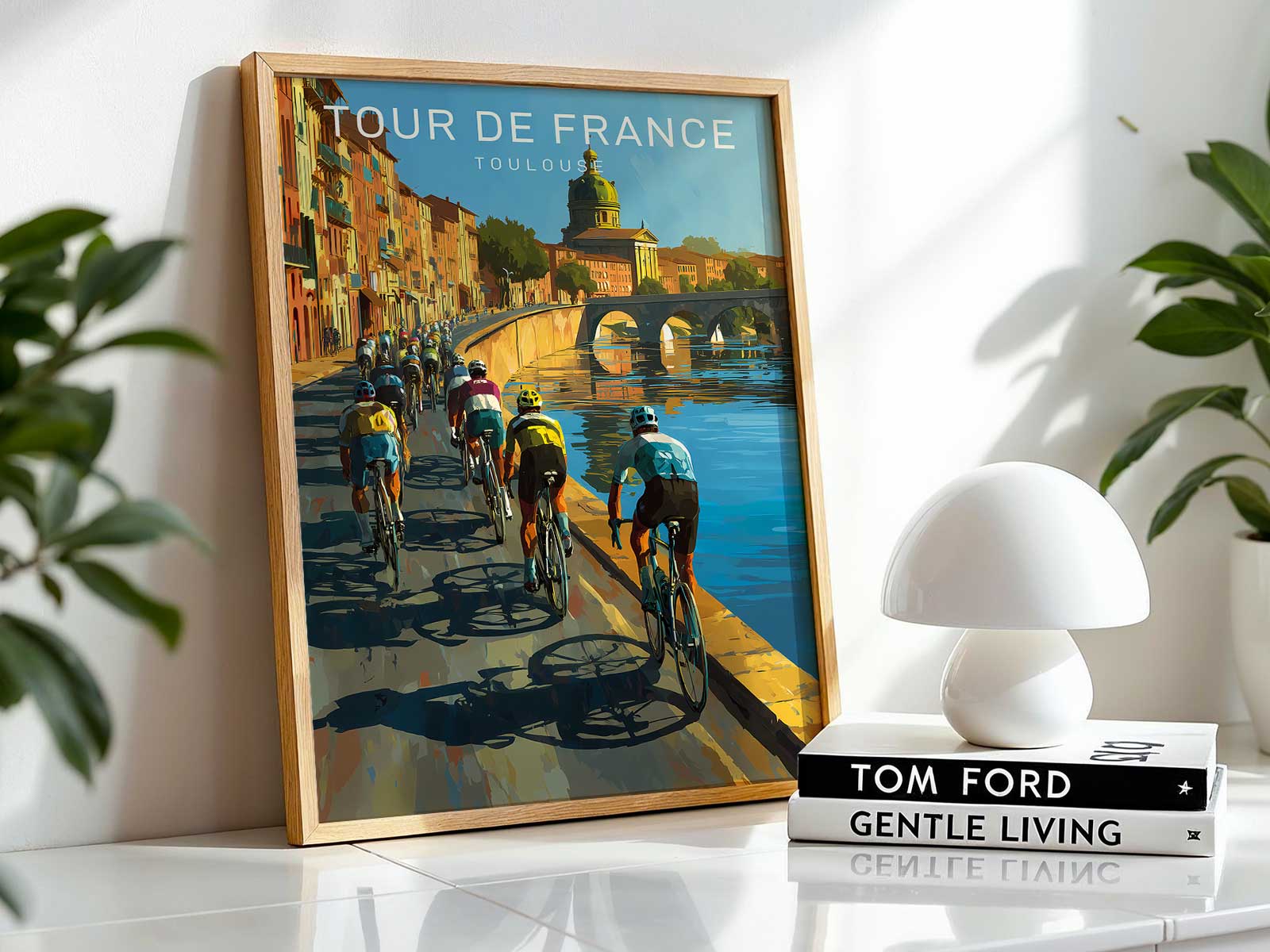
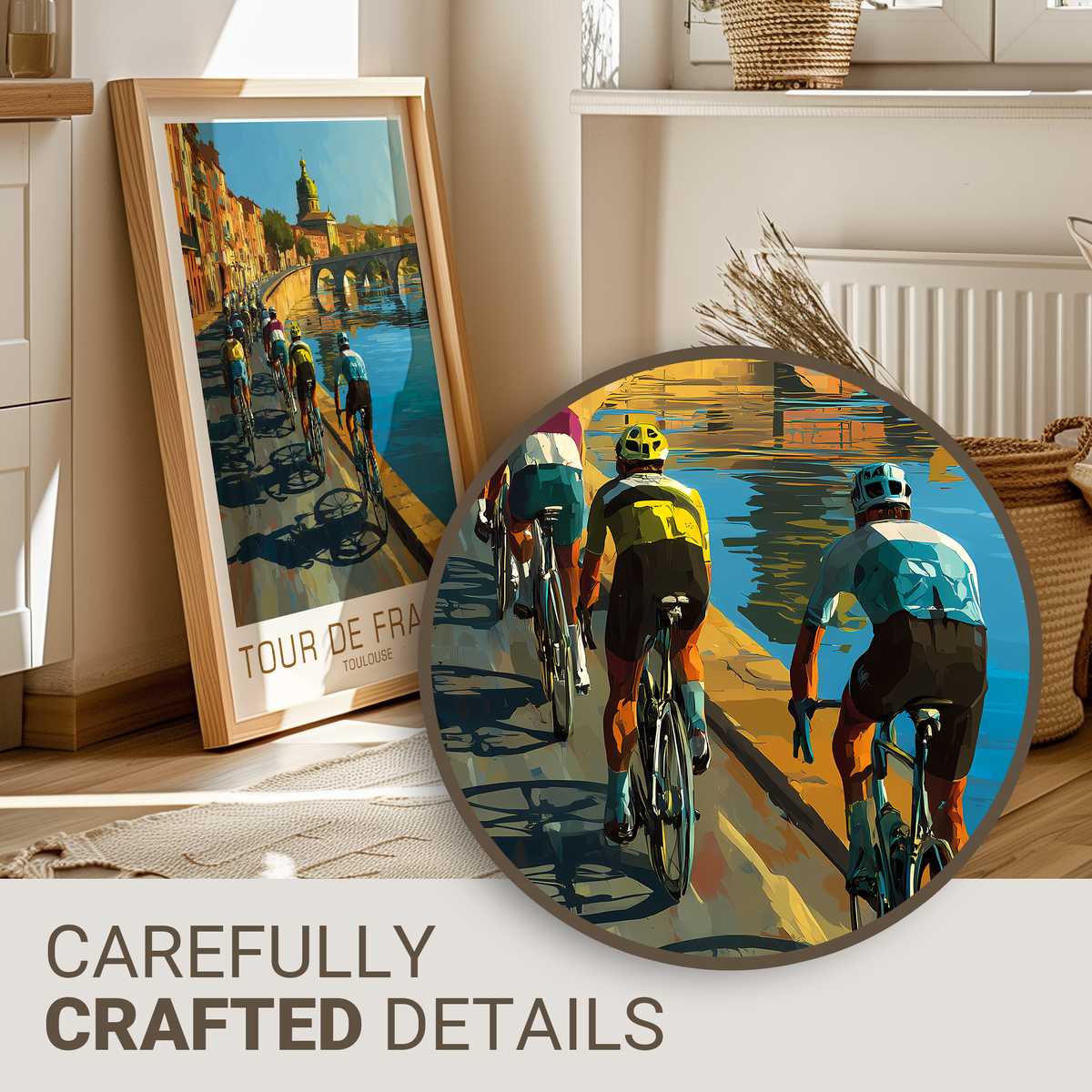
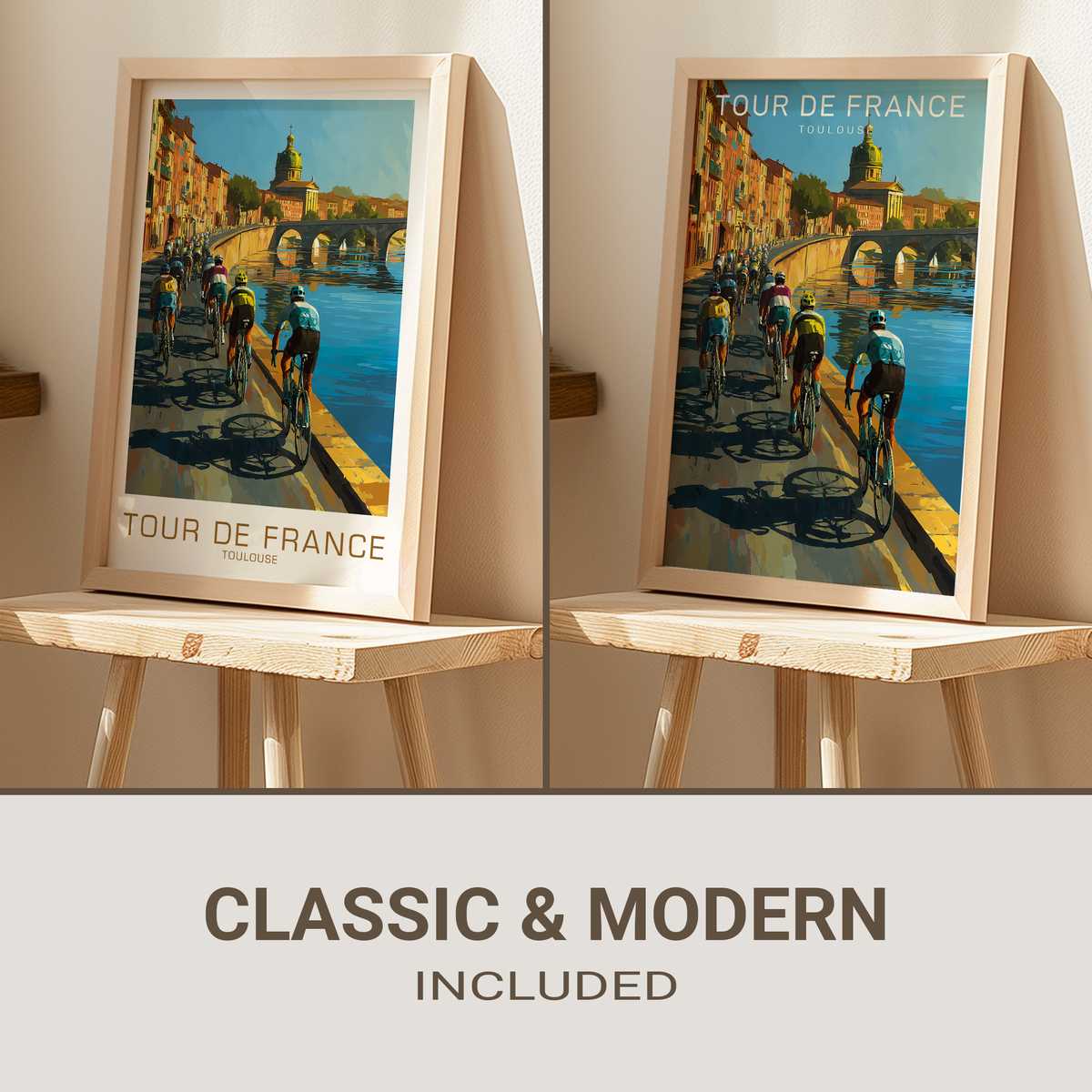
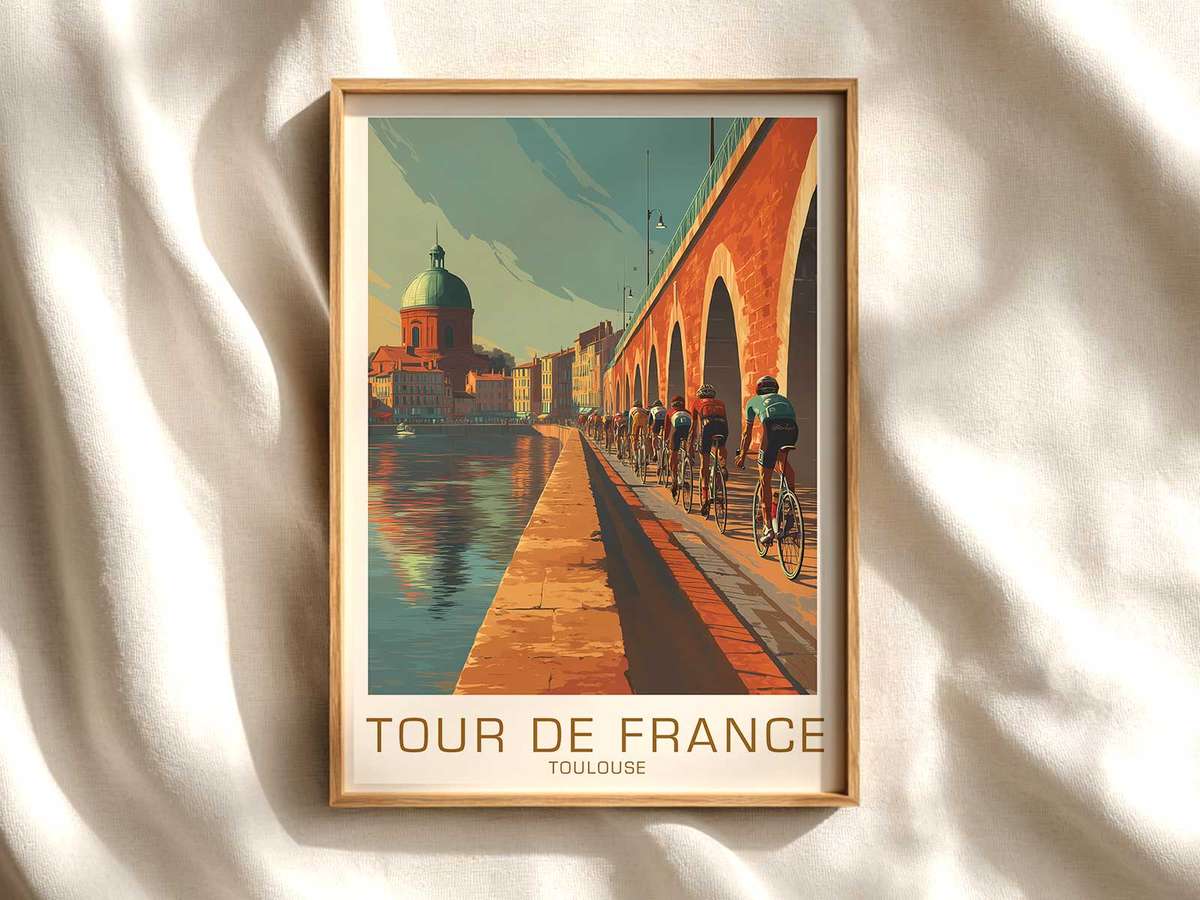
There is a quiet power in an older Tour de France poster anchored to a place like Toulouse: it does not simply depict a stage, it summons a layered memory where local architecture, worn jerseys and the tactile language of print converge. This kind of poster feels lived-in because it reads as an artefact — not a reproduction of a race but a fragment of cultural life. The faded inks, soft-edged lithographic work, and the way a cyclist’s silhouette meets a familiar church tower or riverbank make the image operate as both document and décor.
Look closely and the signs are everywhere: sun-bleached colours that have softened from factory brightness to an intimate palette; the fine grain of paper that catches light differently at the edges; the slight misregistration of a hand-set press that leaves colour overlaps like the fingerprints of an era. Those small imperfections are not accidents but memory cues. They tell a story of posters being pasted to walls, folded into pockets, or pinned in cafés where conversations about training, tactics and towns took place. In a Toulouse-related poster the local becomes part of that narrative — the city’s stones, its plazas and its quiet bridges ceasing to be mere background and becoming witnesses to the race.
[IMAGE_INSERT_ARTICLE_01]
Heritage in cycling imagery functions on two levels. First, there is the iconographic: classic jerseys, tubular wheels, steel frames with lugged joints, and leather saddles that read immediately as belonging to a particular chapter of the sport. These details anchor the viewer in time and invite the imagination to reconstruct the rhythms of a bygone peloton. Second, there is the civic memory: when a poster references Toulouse, it carries the weight of local pride — routes reconceived as communal stories, landmarks turning into emblems. Combined, these elements grant the image a cultural density that elevates it beyond mere nostalgia.
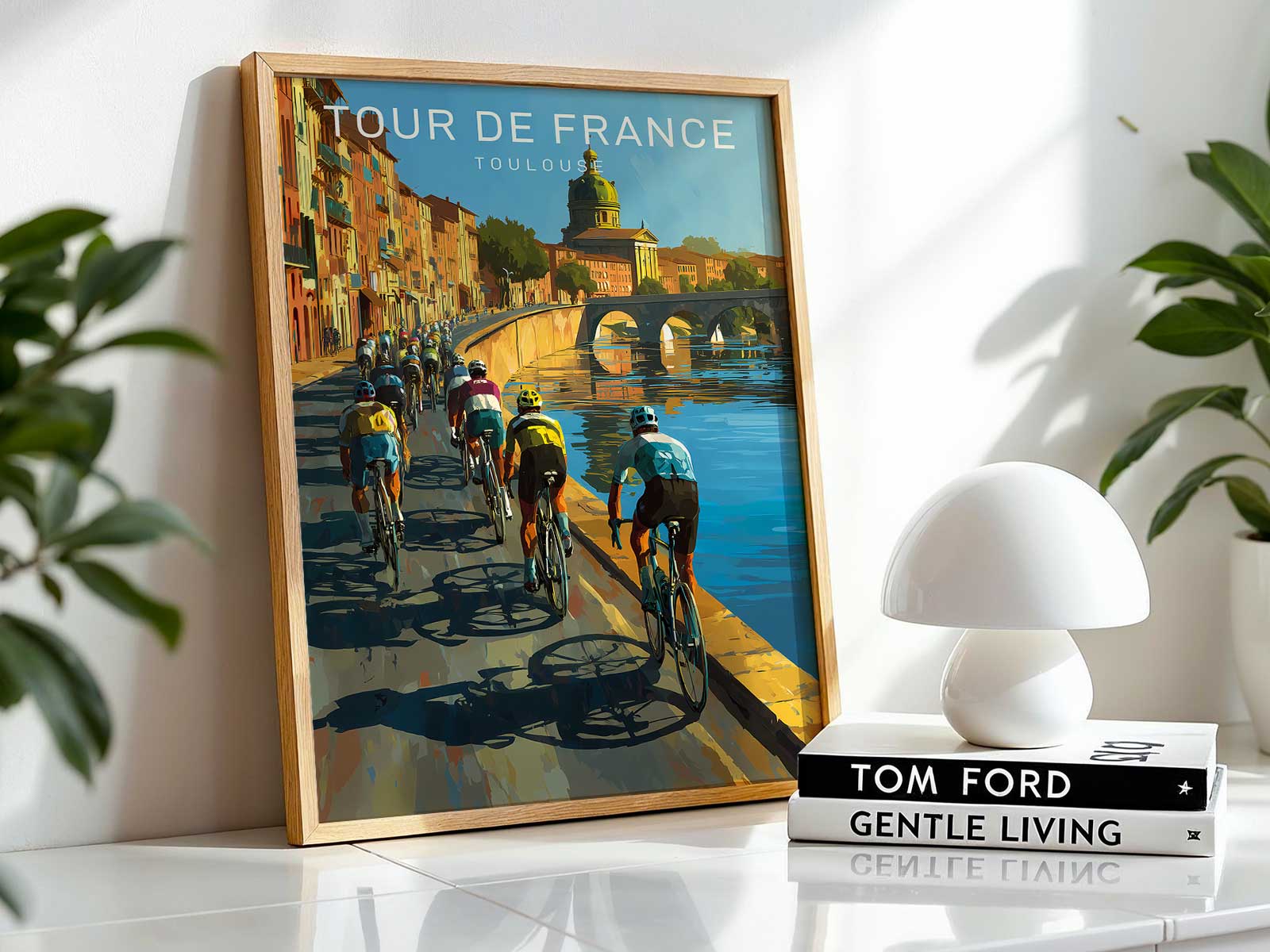
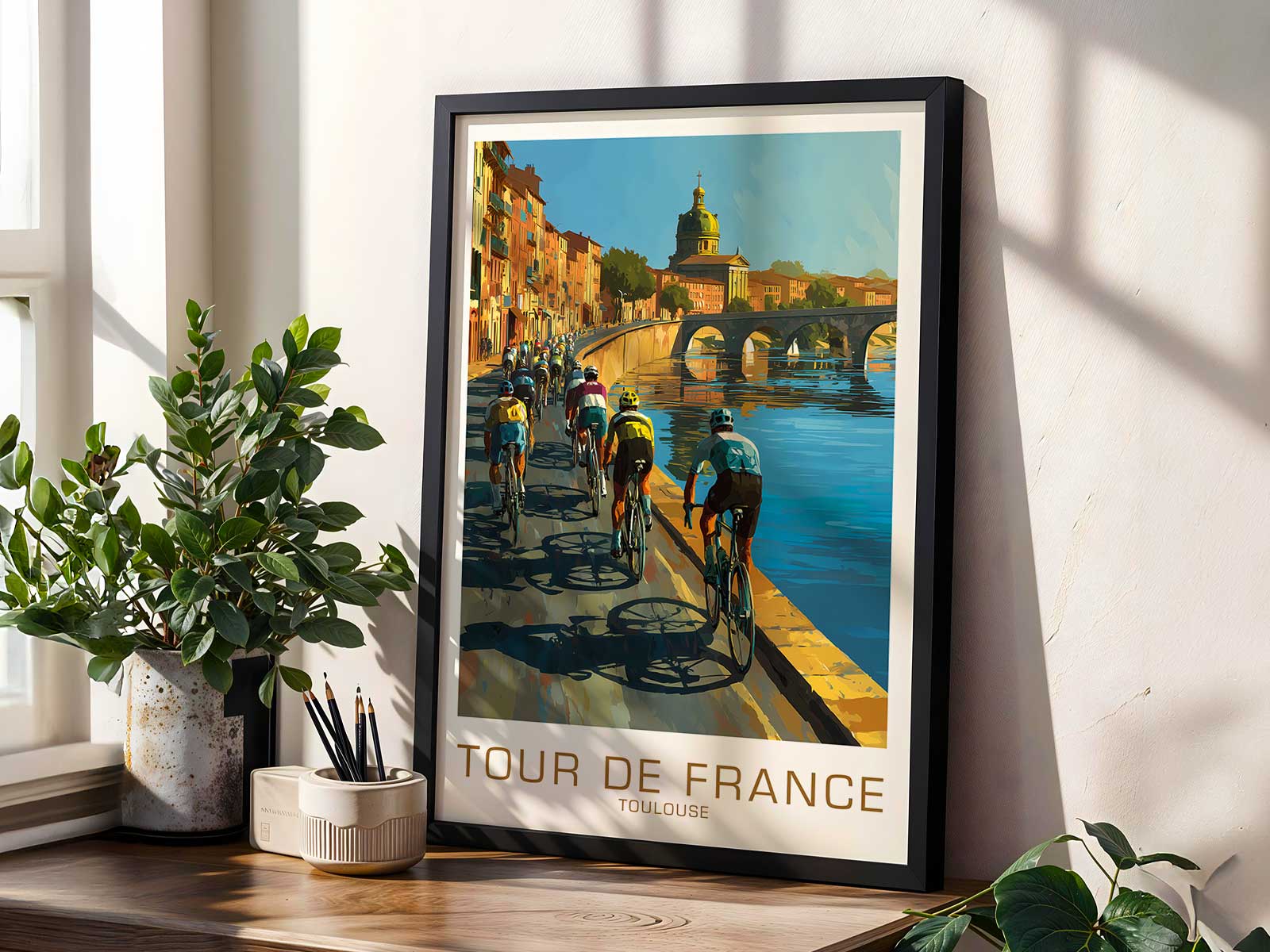
That density is what makes heritage-led Tour wall art succeed in interiors. In a study, a library or a designer’s studio, a vintage Tour poster performs like an heirloom: it introduces texture and a human scale that modern graphic prints often lack. The poster’s soft patina complements wood, leather and linen; its palette tints a room with historical warmth rather than shouting for attention. More than decorative contrast, it offers a conversation piece — a visual anchor that rewards repeated viewing as new details surface: a sponsor’s ephemeral logotype, a number stitched crooked on a jersey, the suggestion of dust along a road.
Collectors and enthusiasts recognise another quality: authenticity of feeling. Contemporary tributes can emulate the look of age, but the archival reading — the sense that paper, press and place have been altered by time — cannot be convincingly faked without losing the spontaneity that makes the image feel honest. A genuine vintage poster carries the accumulation of moments: public viewing, domestic display, the small repairs at the edges. Those marks make the image credible as a historical witness and more resonant as wall art.
Interpreting a Toulouse-linked Tour poster as heritage also changes how we use and place it. Rather than hang it as an isolated sports print, it sits well alongside travel ephemera, maps, and black-and-white photography, where it contributes to a curated narrative about place and practice. It is a decorative object that suggests continuity — of tradition, of communal events and of a living sport — inviting viewers to trace the line from past to present. That continuity is precisely why such a poster feels more rooted: it links the enthusiasm of spectators, the craft of early printing, and the architecture of a city into a single, readable surface.
In the end, a poster that marries Tour de France iconography with Toulouse’s local imprint is rewarding because it asks to be read slowly. It rewards attention by revealing texture, context and time — qualities that transform it from a sporting image into a cultural object. For collectors, for interior-minded buyers, and for anyone drawn to the archive aesthetic, this kind of wall art offers a compact piece of history that hangs comfortably in modern spaces while carrying the warmth of lived memory.