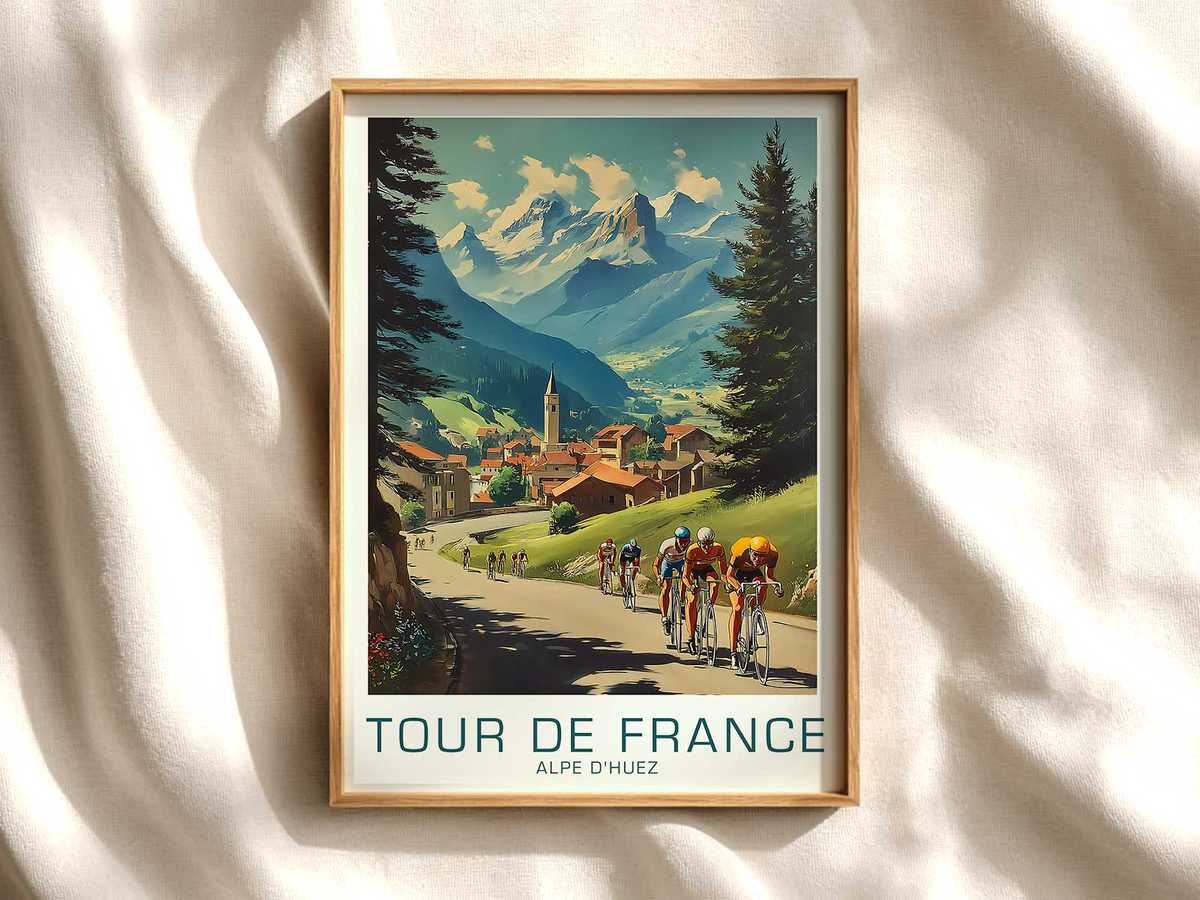
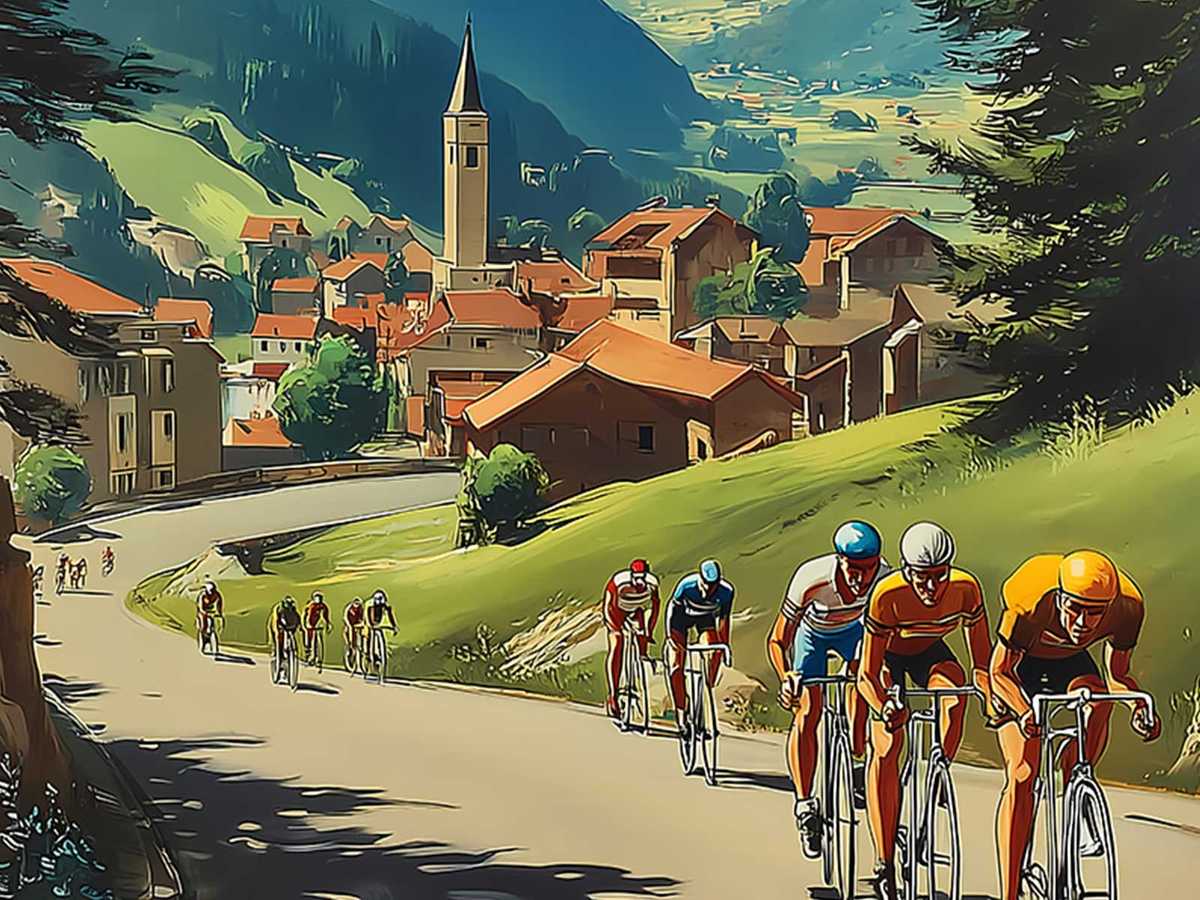
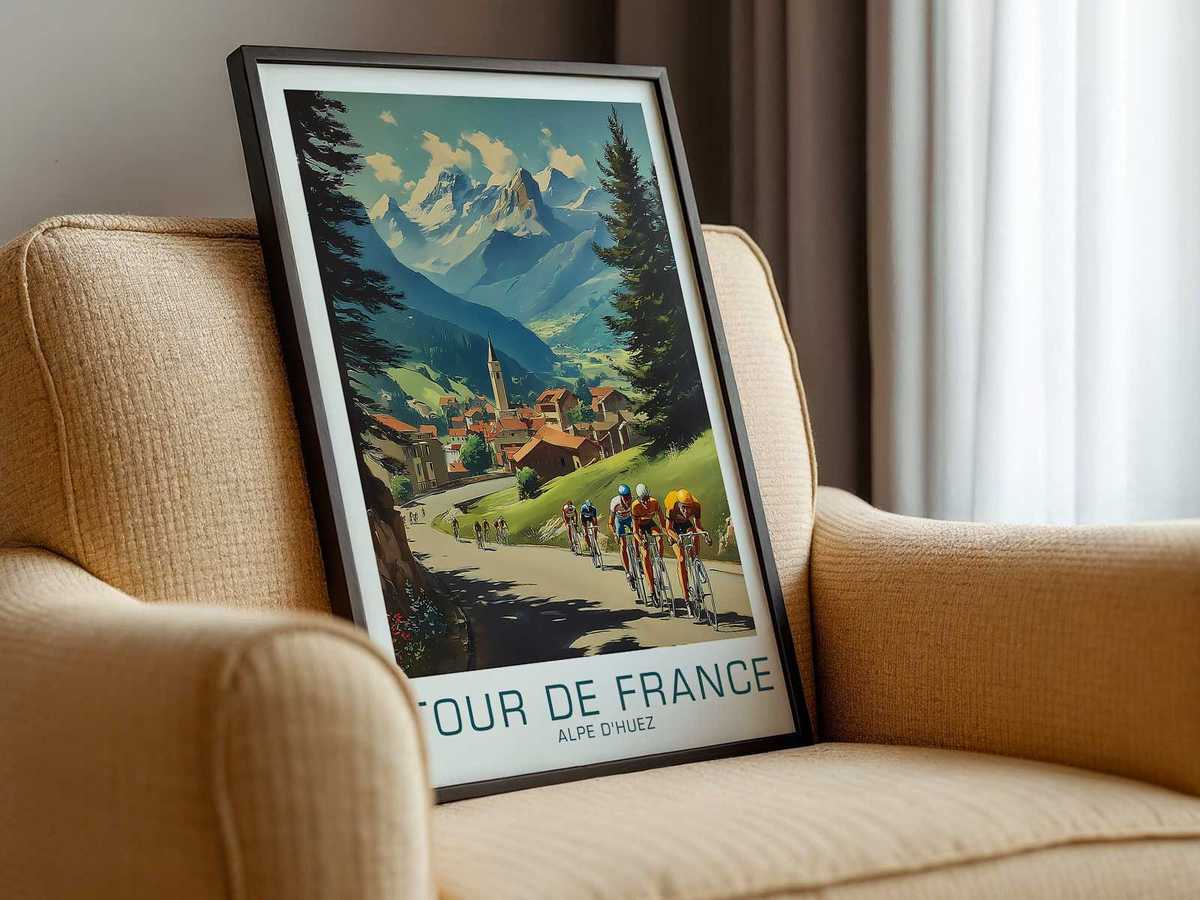
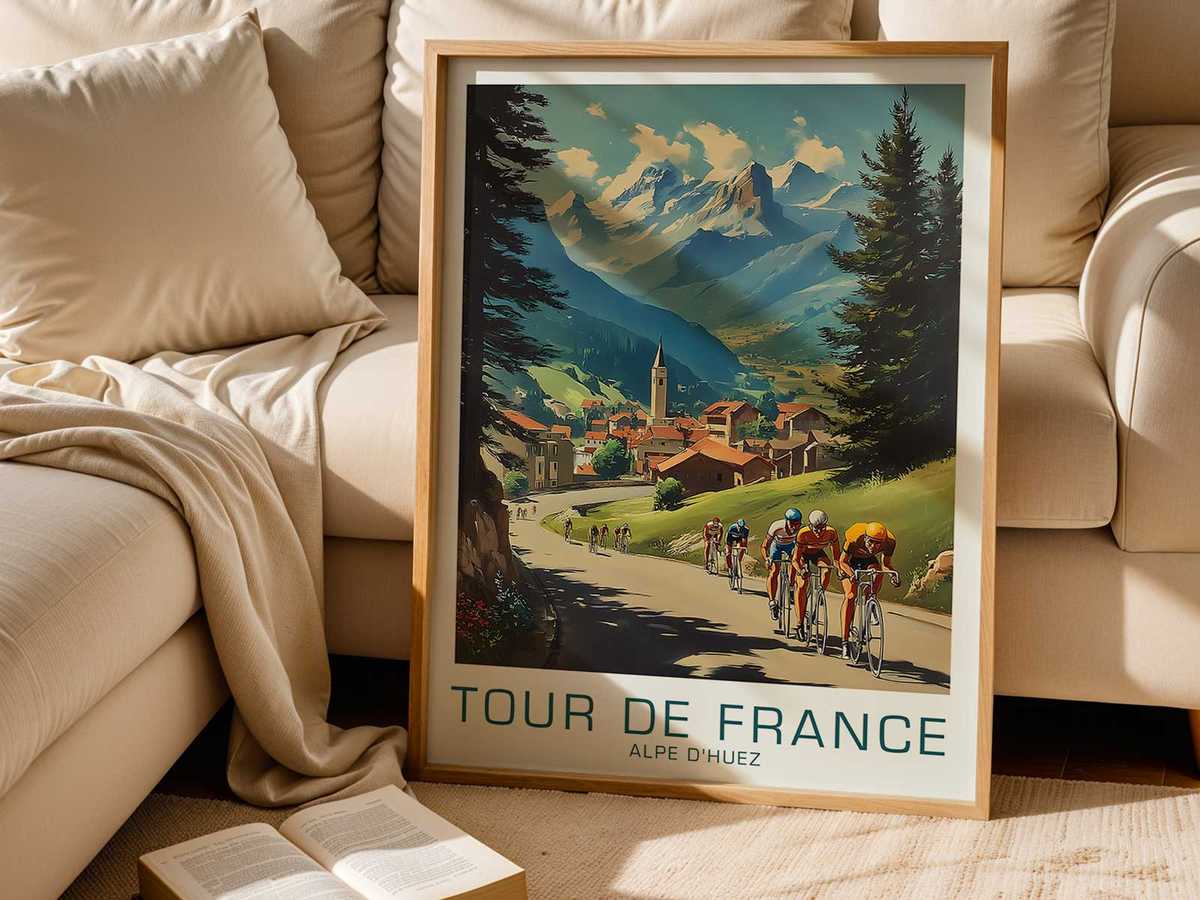
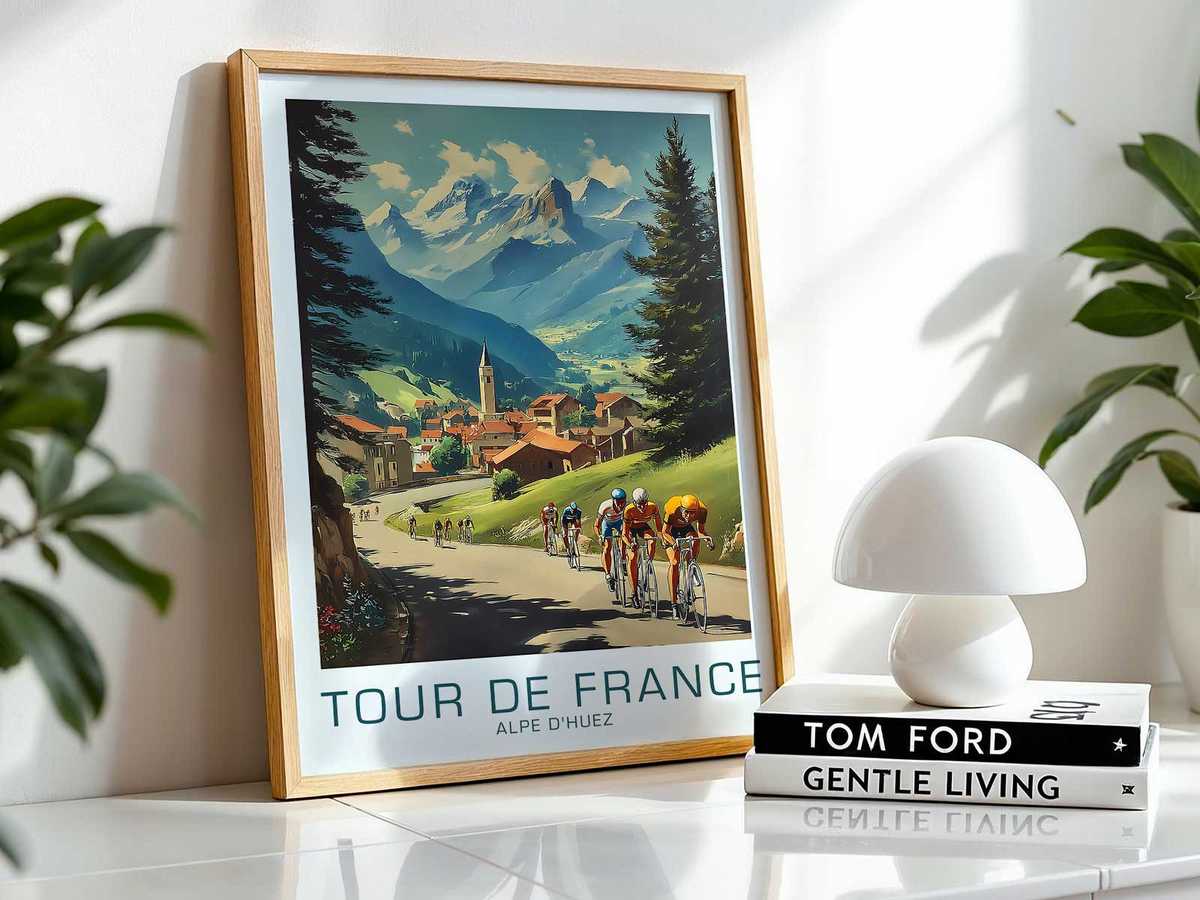
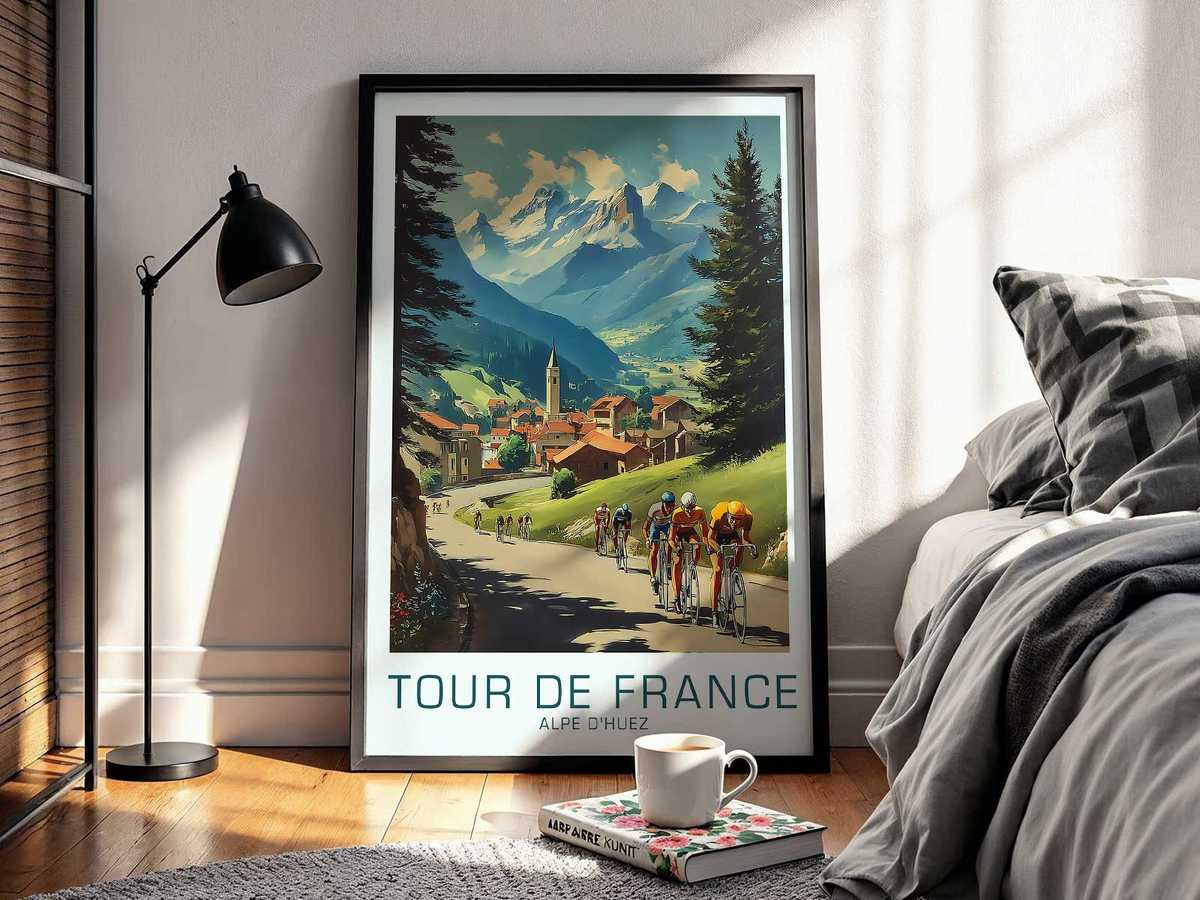
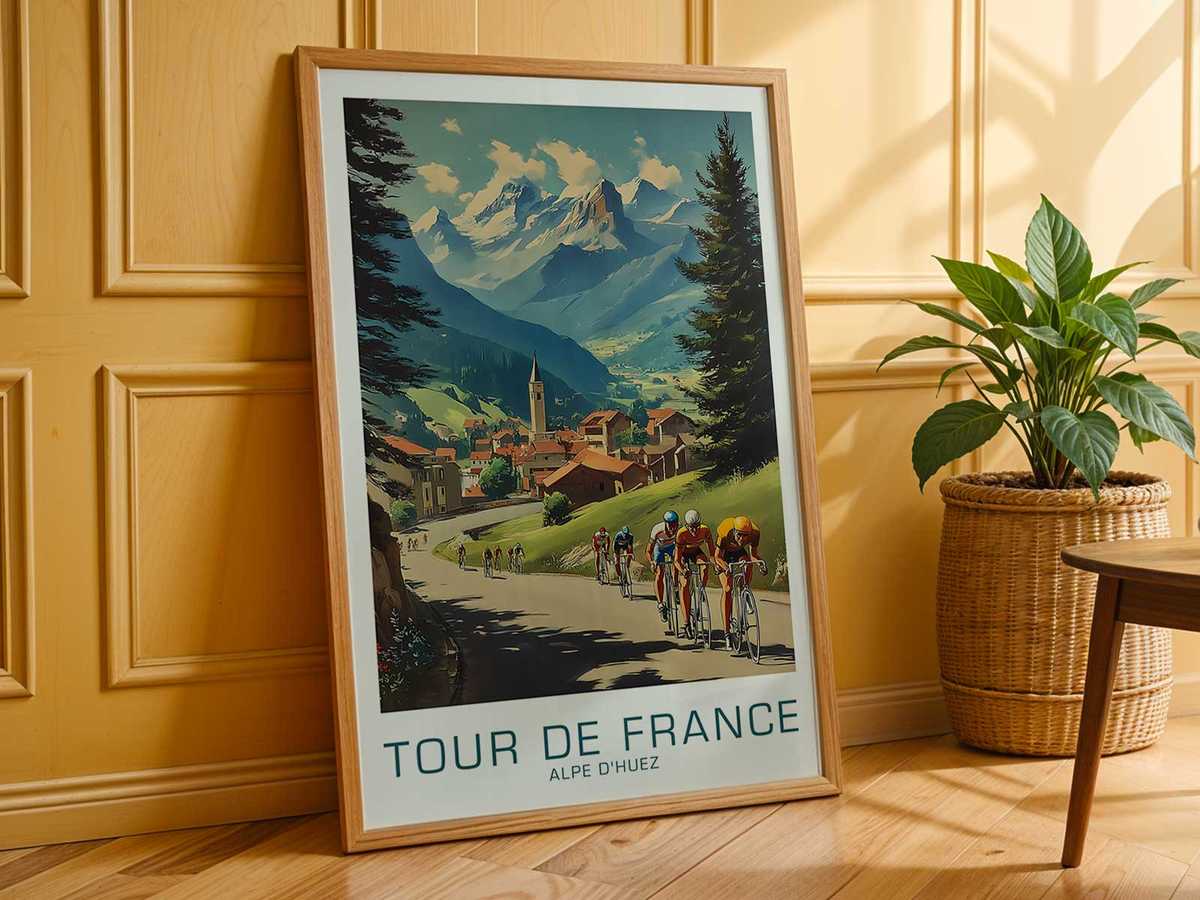
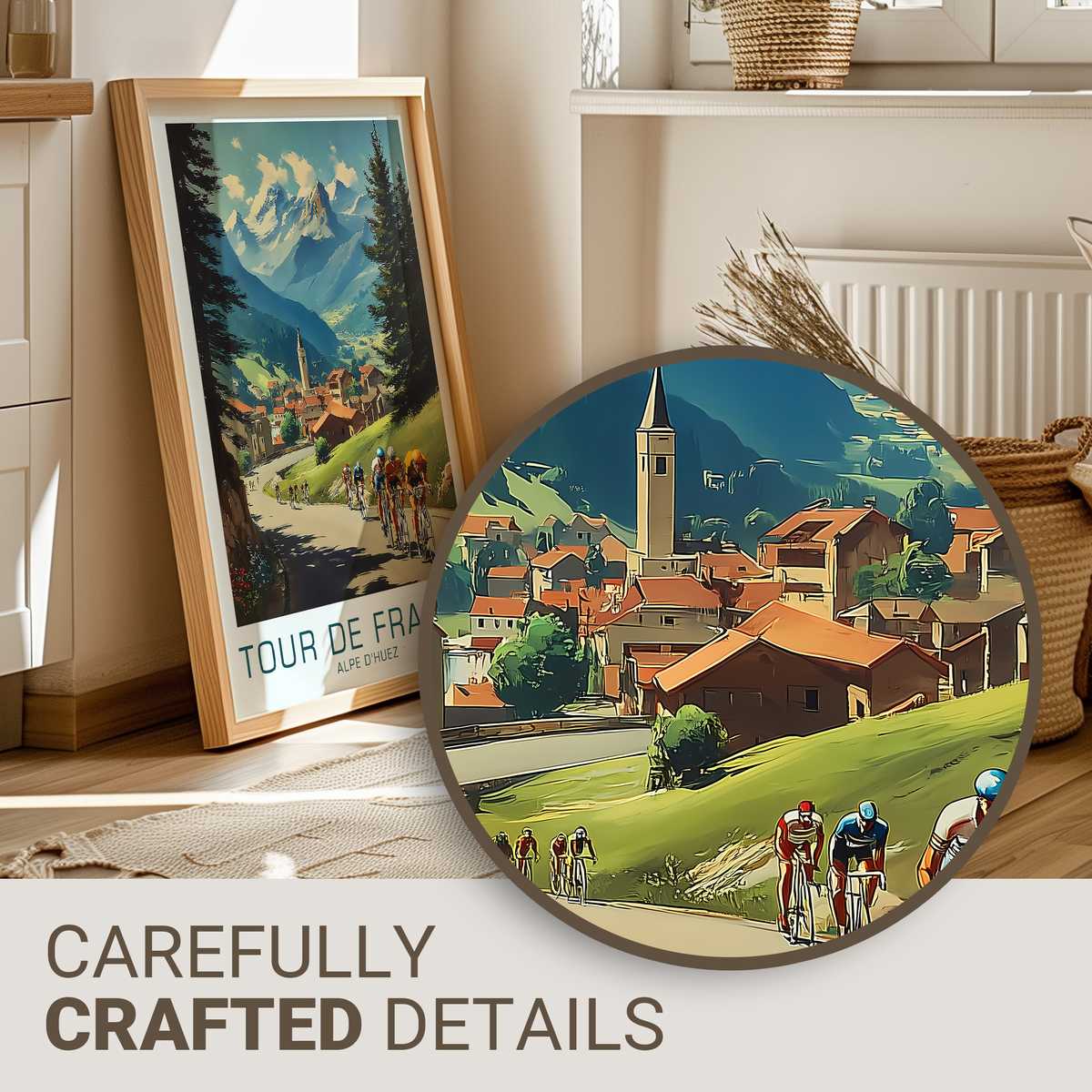
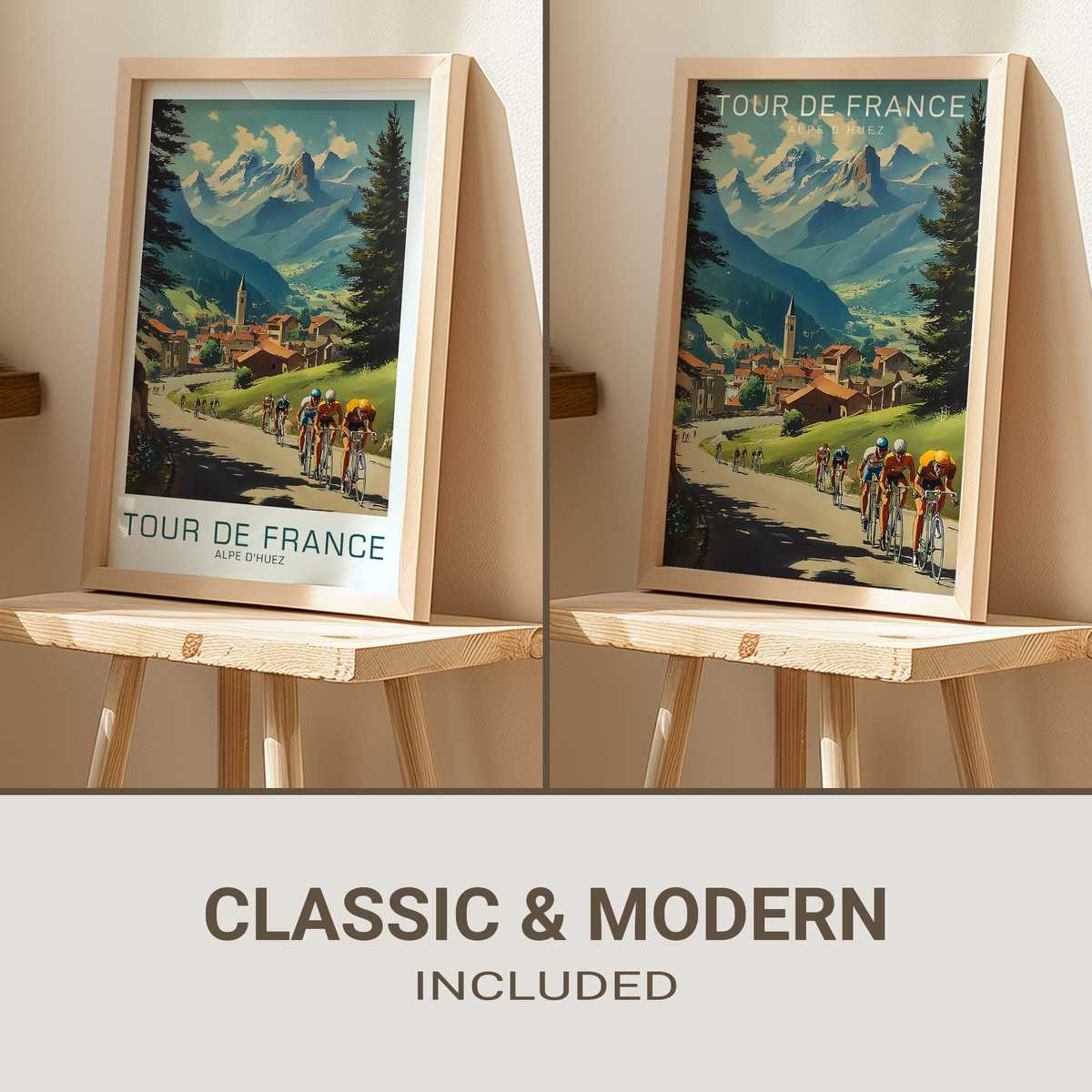
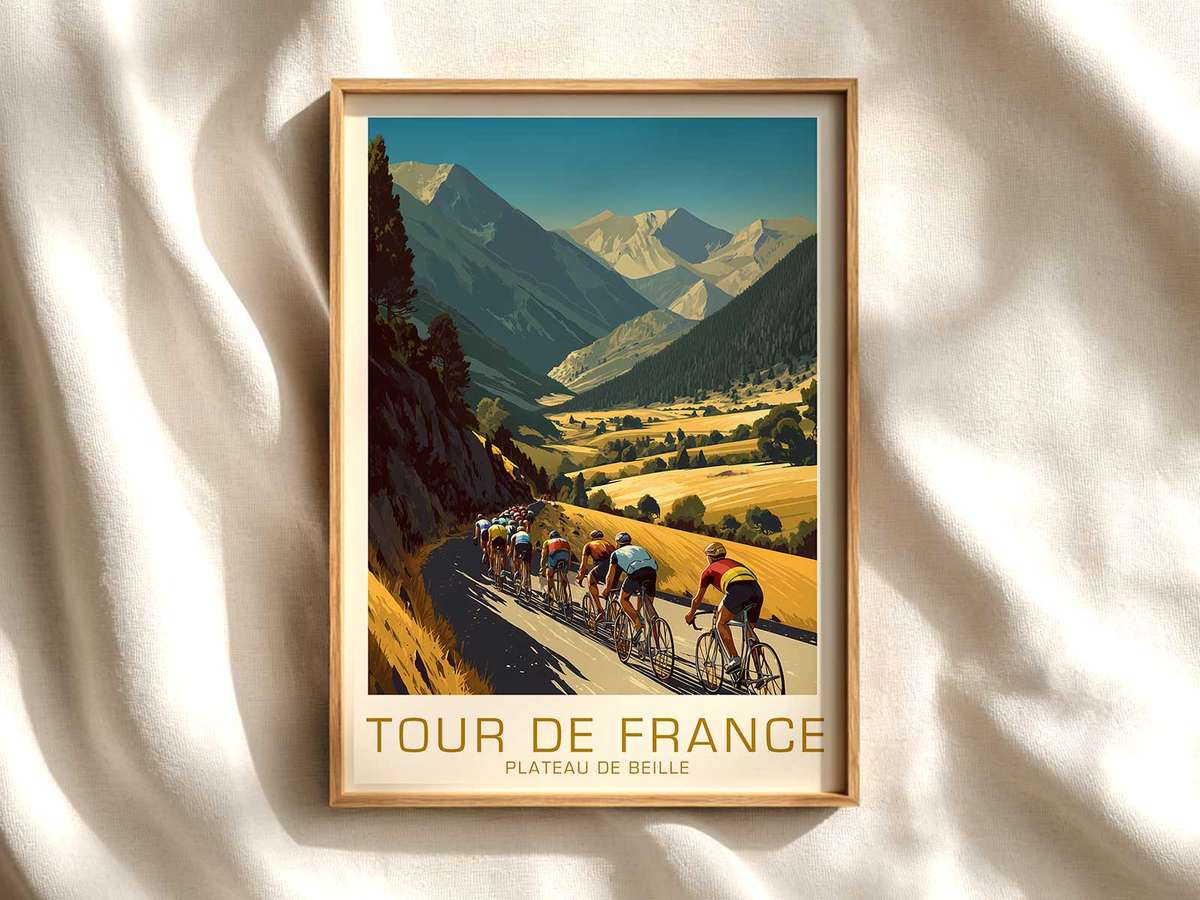
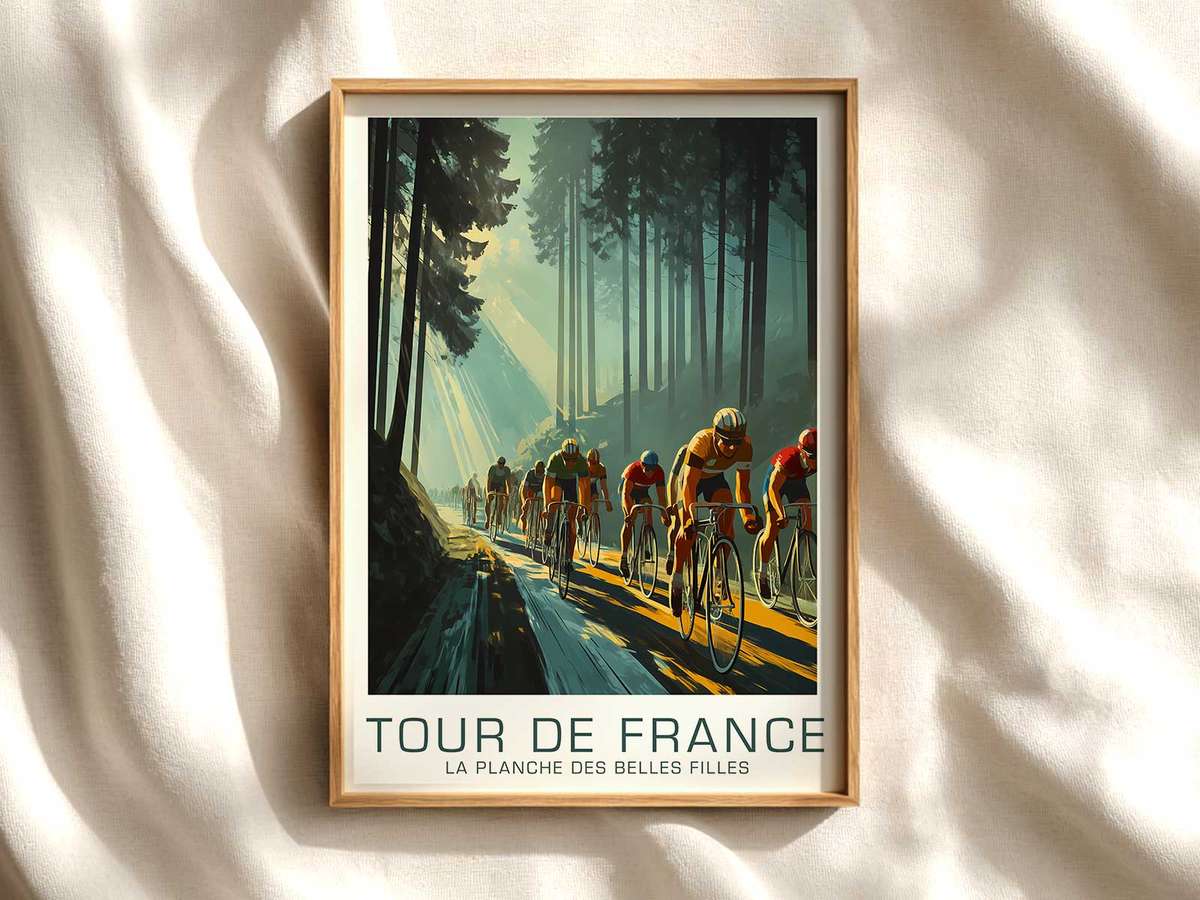
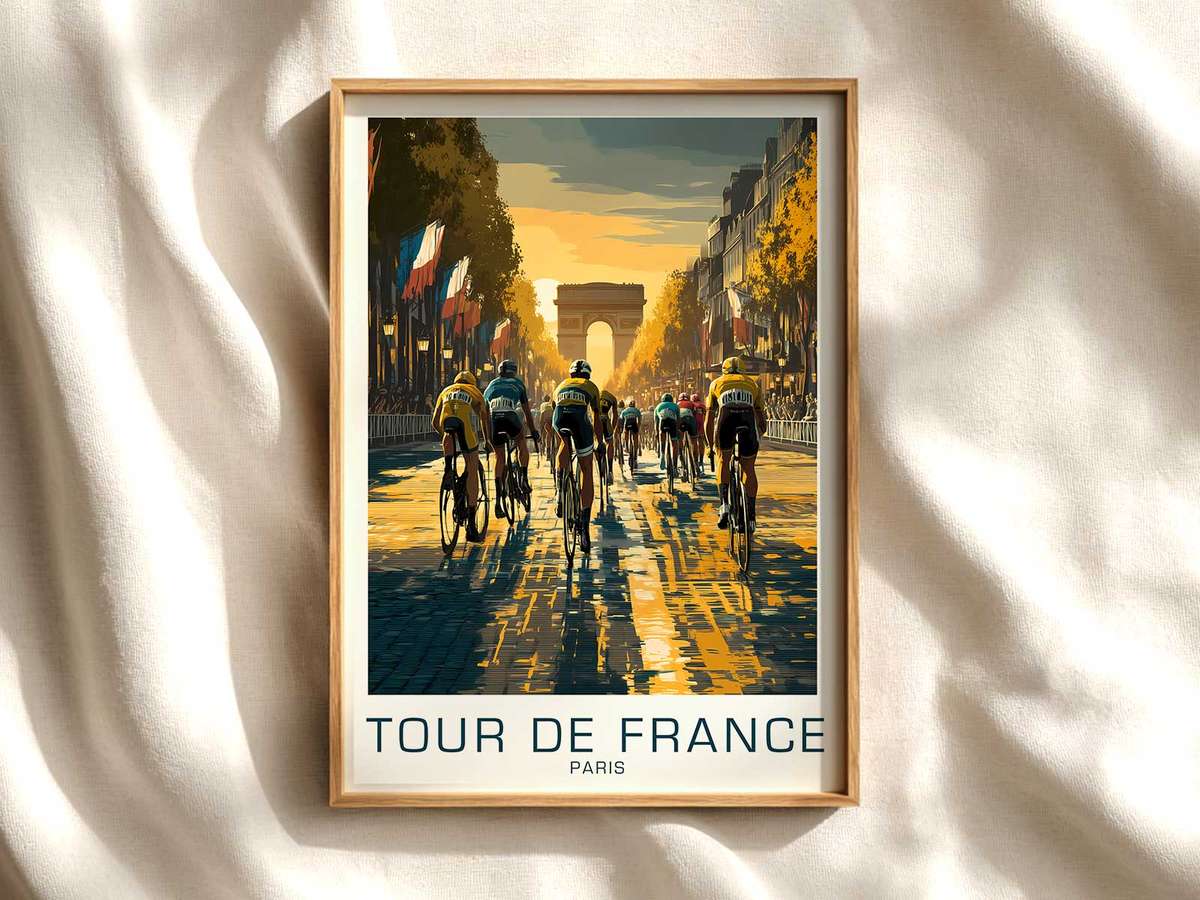
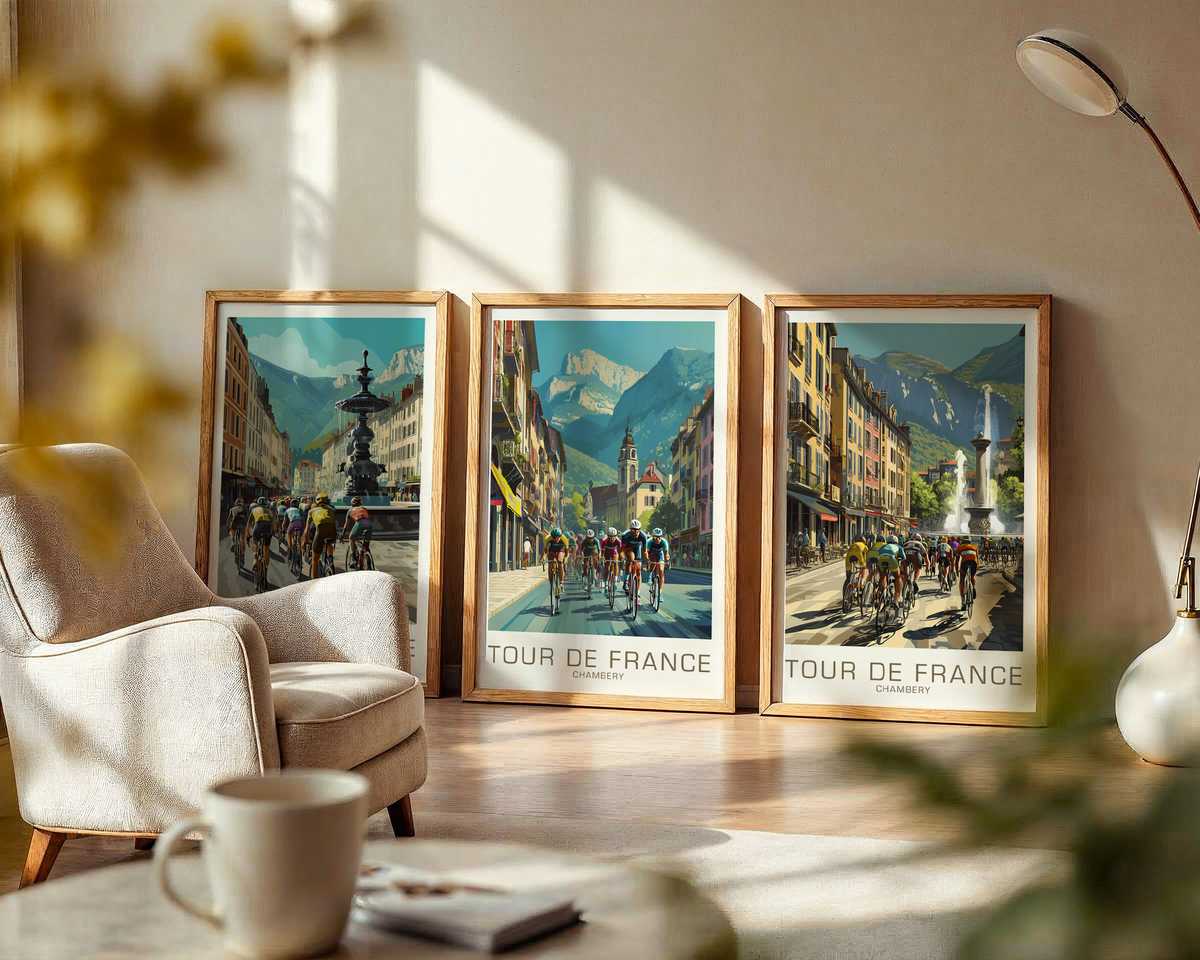
Alpe d'Huez is one of cycling's most instantly recognisable climbs, a stretch of hairpins and steep gradient that has long belonged to Tour de France lore. That recognisability is the foundation for a poster that chooses a single, uncertain race instant as its subject: the second when a rider's posture, the pitch of the road and the neighbourly proximity of rivals together form a small, intense drama. In a metal print the surface amplifies those signals—light picks out sweat, frame lines and tyre angles, while the hard edge of the material gives the scene a sculptural clarity that suits the mountain's austere geometry.
What makes this image read as cinematic is timing. The composition implies an action either just begun or barely contained: a summit attack about to unfold, a chase compressing gains and losses, or a small group negotiating a hairpin while breathing and tactics trade places. The viewer understands fatigue from bent shoulders and clenched hands; the gradient is legible in the road's rise and the riders' cadence. Those cues together tell a full story without caption—courage, calculation and the simple arithmetic of effort versus slope.
[IMAGE_INSERT_ARTICLE_01]
The proximity of rivals in the frame is crucial. When two or three riders are close—their wheels almost overlapping, helmets aligned—the image becomes about pressure as much as power. That visual closeness communicates threat and possibility: an attack could explode forward, a bridge could be closed, or the moment could dissolve into collective endurance. As wall art, this compressed tension reads at both a glance and a longer look; it rewards repeated viewing because the eye can trace strategy in body language and road geometry.
Metal as a medium accentuates the poster's emotional force. Reflections on brushed metal suggest changing light on a mountain morning; contrast becomes sharper, lending the scene an archival crispness that sits comfortably alongside modern interiors. The Alpe d'Huez subject is already loaded with cultural weight—its hairpins and summit finishes are familiar motifs in cycling retail and art—so the print works by evoking shared memories even when it depicts a singular, ambiguous instant rather than a named stage or winner.
Beyond decor, the image succeeds because it isolates the elemental drama of racing: timing, exertion and decision compressed into one frame. This is not simply about a beautiful bicycle silhouette or a pretty landscape; it is an emotional archive of endurance. In a study, office or living room the poster offers a focused counterpoint to everyday calm, a reminder that a single second of sport can contain risk, resolve and narrative direction. That restrained intensity—rather than overt heroics—gives the artwork its quiet authority.
Collectors and viewers respond to such images because they are interpretable. The viewer invents what came before and after: the attack that may have started it, the riders who might respond, the summit where hope or despair will be decided. This imaginative gap is an advantage for wall art: the piece becomes a conversation starter, a memory trigger for those who know Alpe d'Huez as a cycling destination, and a visual focal point for anyone drawn to composed, tension-rich scenes.
When a single race instant is rendered with visual precision—clear body lines, leg strain, steep road, and the close-cropped rivalry of competitors—it becomes more than a momentary spectacle. It becomes a durable image of endurance and choice, one that the metal surface helps preserve and present with a contemporary, gallery-like presence. For interiors that value narrative, movement and a refined cycling aesthetic, such a poster translates a precarious second on Alpe d'Huez into a lasting, emotionally charged object of attention.