How Louison Bobet Built a Palmarès Around Three Consecutive Tour de France Wins
Louison Bobet's record is best read through sequence and consequence: a clear emergence culminating in three consecutive Tour de France victories (1953–1955), framed by major classic wins and a 1954 world championship that together converted a talented professional into a defining French champion of the early 1950s.
Quick answer
Bobet's palmarès is built around a rare sporting sequence: repeated overall success at the Tour de France supported and amplified by big one-day victories and a world title that together mark him as an all‑round champion rather than a one-off winner.
What this breakdown covers
- How Bobet's Tour de France results created a career-defining peak.
- How classics and the 1954 UCI World Championship reinforced his stature.
- How to read the palmarès as sequence: emergence, peak, and sporting consequence.
The palmarès at a glance
Louison Bobet is foremost remembered for winning the Tour de France three years in a row: 1953, 1954 and 1955. He also won the UCI Road World Championship in 1954 and collected major one-day victories including Milan–San Remo (1951) and the Tour of Flanders (1955). Databases commonly list multiple Tour de France stage wins for Bobet, frequently cited as twelve across his career.
The first results that mattered
Bobet's rise did not arrive out of nowhere: early classic success such as Milan–San Remo in 1951 signalled an ability to win big races on the calendar beyond stage racing. Those one-day wins matter because they show the rider's versatility — a necessary condition for later Grand Tour general classification ambitions in an era when riders were expected to be all-rounders.
The years of real ascent
The decisive phase for Bobet is the early 1950s when his results moved from individual classics and stage wins toward sustained overall contention. The breakthrough is visible in the sequence of Tour de France results that began with an overall victory in 1953 and continued through 1954 and 1955. That continuity is the clearest indicator that Bobet transitioned from a rider who could win big races to a rider capable of repeating overall excellence at the Tour.
Tour de France impact and big-race weight
Bobet's three consecutive overall wins at the Tour de France (1953–1955) are the central pillar of his palmarès. In the post‑war era he became the first rider to win three straight Tours, a feat that established him as the dominant French rider of the early 1950s. Those overall victories carry greater weight than individual stage tallies because repeated GC success shows management of form across three weeks and multiple terrains.
Peak seasons and defining runs
1954 stands out as a defining season: Bobet retained the Tour title and also won the UCI Road World Championship that year. Combining a Tour GC victory with the world title in the same season is a rare double that confirms the peak was more than a single flash. The presence of major classic wins before and during this period (Milan–San Remo in 1951; Tour of Flanders in 1955) shows the peak was grounded in an all‑around competence.
Records, jerseys and numerical clues
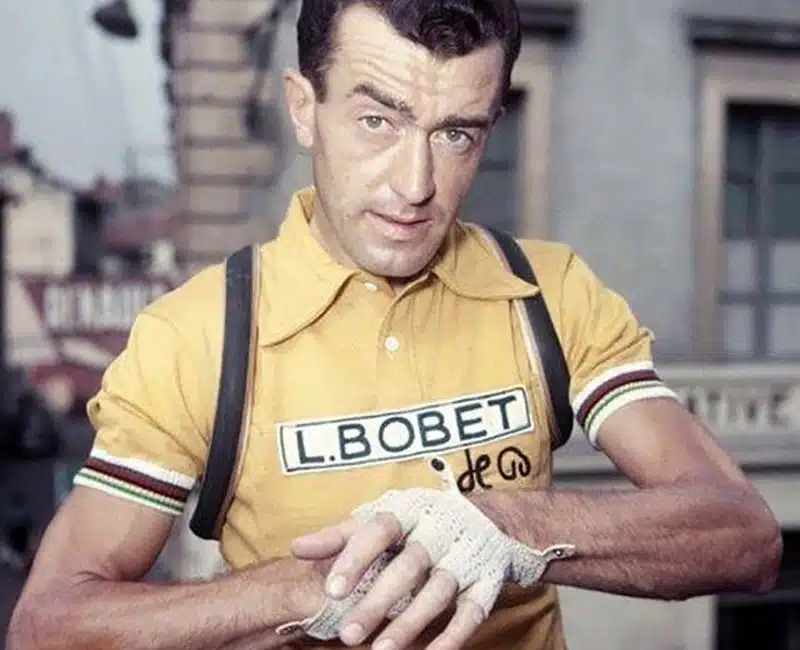
Numbers attached to Bobet are meaningful when placed in context: three consecutive Tour victories mark dominance over multiple seasons rather than a single extraordinary year. The commonly cited total of around twelve Tour stage wins (database figures) complements the overall results — stage wins indicate tactical and day‑to‑day superiority, while the consecutive GC titles show strategic and seasonal management. The 1954 world championship acts as an external validation of his form that season.
Consistency versus explosive peaks
Bobet's career reads as the blend of a sustained peak and the capacity to repeat excellence. Winning the Tour three times in succession is the clearest proof of repeatability: it requires more than one exceptional preparation or luck in a single race. The world championship and major classic victories punctuate that consistency with distinct high points, converting a Grand Tour specialist label into a broader champion identity.
What the palmarès says about the rider
Read together, Bobet's Tour streak, his classics victories and the 1954 world title define him as an all‑rounder who could both win single-day monuments and manage the three-week demands of the Tour de France. His record places him among post‑war cycling's formative figures: not merely a one-time winner but a repeated national and international reference point for French cycling.
How the record lives in cycling memory
Bobet's three consecutive Tours are the headline and the durable part of his memory in the sport. Those editions and the 1954 world title are the reasons he remains a benchmark when historians and fans assess early post‑war champions. The balance between classics and Grand Tour victories prevents his palmarès from feeling single-dimensional — it is a career built around repetition and validation across race types.
Final take
Louison Bobet's palmarès is shaped by sequence: early classics showed the capacity to win, a three-year Tour run converted that capacity into dominance, and the 1954 world title confirmed a true peak. The result is a record that reads as sustained greatness rather than isolated triumphs.
Author: William L.