Fausto Coppi: Reading a palmarès shaped by mountain supremacy and post‑war…
Fausto Coppi’s record is best read as a two-part story: extraordinary Grand Tour success concentrated on the Giro d’Italia and two decisive Tours de France, and a reputation built on mountain superiority that reshaped how cycling was watched and discussed in the post‑war era. This article traces how the results that mattered most accumulated across seasons and why Coppi’s palmarès still defines an era.
Quick answer
Coppi combined five Giro d'Italia overall victories with two Tour de France wins, completed the Giro–Tour double twice (1949 and 1952) and is remembered principally for mountain dominance and his central role in post‑war cycling’s modern narrative.
What you will learn here
- How Coppi’s major victories stack between Giro and Tour results.
- Which seasons created his defining reputation, especially 1949 and 1952.
- Why mountain superiority and media context made his palmarès historically transformative.
The palmarès at a glance
Concrete career anchors: Coppi won the Giro d'Italia five times (1940, 1947, 1949, 1952 and 1953) and the Tour de France twice (1949, 1952). He also won the UCI Road World Championship in 1953 and secured multiple Monument victories; these Grand Tour and classic results form the numerical spine of his legacy.
The first results that mattered
Coppi’s earliest Giro success (1940) established him before the major disruptions of World War II. Returning to competition after the war he rebuilt momentum and captured further Giro wins in the late 1940s, a continuity that placed him at the centre of rebuilding Italian and European cycling narratives.
The years of real ascent
The immediate post‑war seasons are where Coppi’s palmarès moved from national talent to international benchmark. Wins in the Giro after 1945 led into an expanded programme of major races, and by 1949 he converted Giro success into the first of his two Tour de France overall victories — a turning point that signalled his capacity to win Grand Tours beyond Italy.
Tour de France impact and big race weight
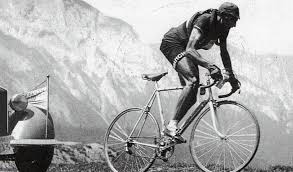
Coppi’s Tour wins in 1949 and 1952 carry heavy weight because they were paired with Giro triumphs in the same years, creating the first Giro–Tour doubles and demonstrating Grand Tour versatility. The 1952 Tour is particularly noted in historical sources for an Alpine performance that underlined his dominance in the mountains and amplified his international profile.
Peak seasons and defining runs
Two seasons stand out as defining peaks: 1949 and 1952. In both years Coppi won the Giro and the Tour, completing the Giro–Tour double and showing not just momentary superiority but the ability to sustain peak form across consecutive Grand Tours in the same season. Those doubles are milestone markers in his career narrative.
Specialist identity: mountains and all‑round power
Historical and scholarly accounts emphasise Coppi’s mountain superiority and his identity as both a climber and a powerful rouleur. That mix allowed him to gain time in high mountain stages and control races on long solo efforts, behaviours reflected in his Grand Tour victories and in the way contemporary sources described his performances.
Records, doubles and numerical clues
Key numbers to hold: five Giro overall victories and two Tour wins, plus being the first rider to complete the Giro–Tour double twice (1949 and 1952). The 1952 Tour is repeatedly cited for an exceptionally large winning margin and for Alpine stages that became part of Coppi’s mythos; together these figures underline both superiority and historical significance.
How the results fit the era
Coppi’s career must be read against the post‑war context. His rivalry with contemporaries, extensive media coverage of Alpine performances and the growth of international interest in the Tour turned individual results into cultural moments. Scholars place Coppi at the centre of cycling’s transformation after World War II: his victories were sporting achievements and cultural events that helped modernise the sport’s image.
What the palmarès says about the rider
The distribution of Coppi’s wins — heavy on the Giro, landmark Tours and important one‑day titles including the World Championship — paints the picture of a complete leader whose defining tool was climbing. Rather than a sprinter or specialist time‑trial specialist alone, his record shows a rider who could dominate mountains, win Grand Tours across seasons and collect major classics to broaden his impact.
How the record lives in cycling memory
Coppi’s palmarès continues to matter because it combines rare statistical achievements (multiple Giro wins, two Tours, two Giro–Tour doubles) with narrative weight: iconic Alpine performances and post‑war cultural resonance. That blend explains why historians and fans still treat his career as a pivot between pre‑war traditions and the modern international era of cycling.
Author: Alex R.